LLMs & AI Agents · RAG in MedTech
How RAG Automates Security and Compliance Questionnaires in MedTech
Hospitals require MedTech vendors to complete extensive security questionnaires before using their products. At apoQlar, each one took around a month and eight to ten people. An assistant based on retrieval-augmented generation now answers the questions from verified documents, with sources.
 Aleksandra Osztynowicz

Key takeaways
- Retrieval-augmented generation connects language models to company documents and delivers verifiable answers with sources.
- At apoQlar, processing time for security questionnaires fell by 75%, from around one month to under one week.
- Onboarding new hospital clients shrank from six weeks to two, and a small team now reviews instead of eight to ten people.
- Success factors are good data quality, a clearly defined use case, early prototyping and continuous monitoring.
Retrieval-augmented generation (RAG) combines the language capabilities of large language models with a company’s data and documents. The result is AI systems that deliver precise, current and verifiable information from internal sources. In regulated industries such as medical technology, where security and compliance documentation must be efficient, accurate and traceable, that makes a big difference.
The challenge: security questionnaires before every hospital project
The Hamburg-based MedTech company apoQlar develops mixed reality and AI solutions that bring holographic imaging into the operating room. Before a hospital introduces such a platform, it requires a completed security questionnaire. These questionnaires assess data protection, IT security, regulatory compliance and technical integration, and contain dozens to hundreds of questions on topics such as encryption, access control, incident management or software architecture.
For apoQlar this meant considerable effort. A single questionnaire took around a month and tied up eight to ten people from IT, quality assurance, compliance and legal, even though the answers already existed in internal documents. Every question had to be checked against manuals, security policies and technical documentation. The result was high personnel costs, long lead times and delays in hospital rollouts.
The solution: an AI assistant based on RAG
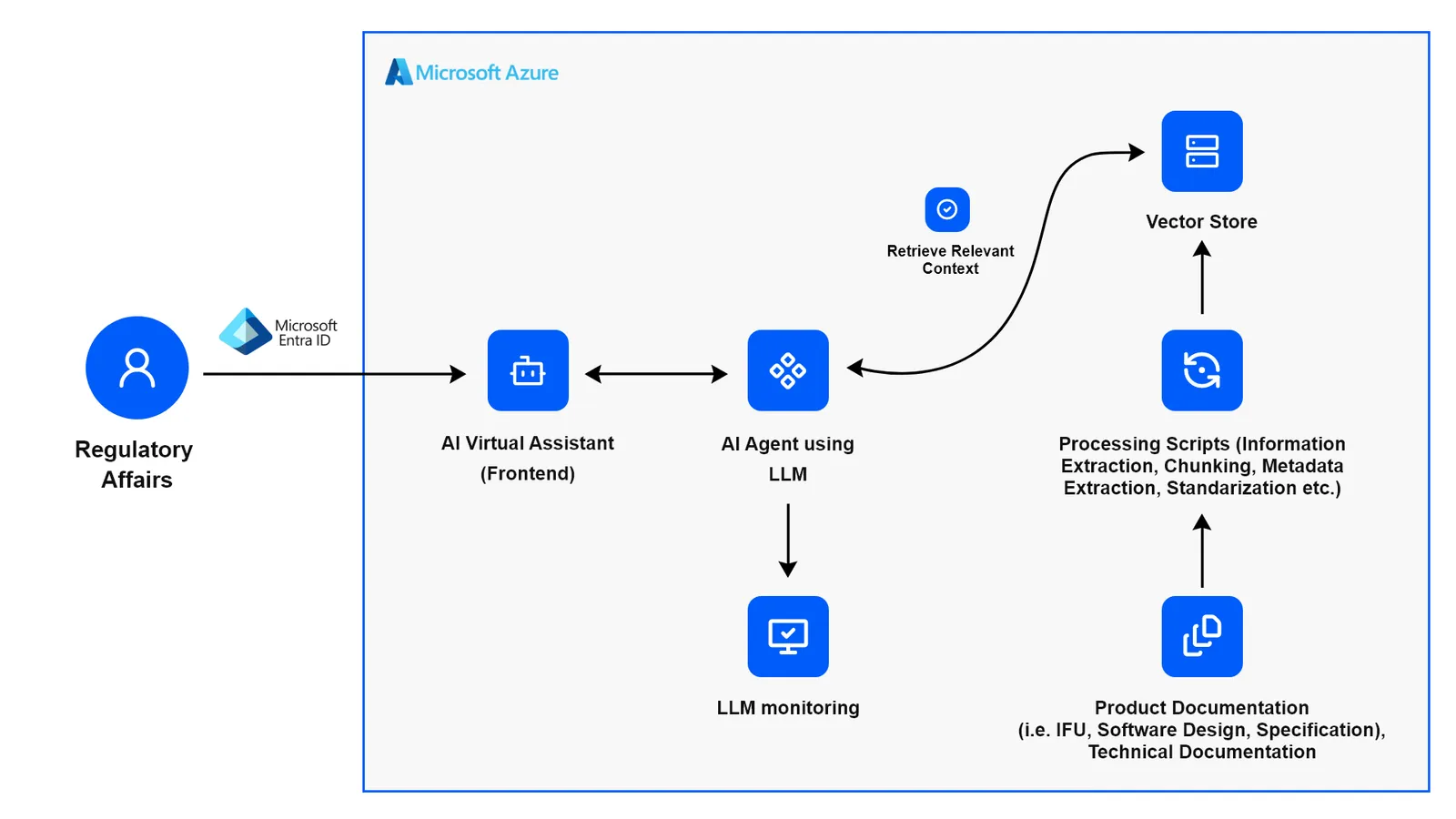
Together with apoQlar we built an assistant that retrieves and drafts answers from all relevant company sources. Policies and technical documentation, previously scattered across PDF files and Confluence pages, were consolidated into a central knowledge store.
On top of it runs “Zippy”, an assistant using Azure OpenAI Services as the language model, ChromaDB as the vector database and a secure Azure infrastructure. This combination ensures scalability, data protection and traceability, core requirements for AI in regulated industries. For every answer, Zippy cites the exact source, including document name and page number.
The solution is a web application with a chat interface. It answers specific technical or regulatory questions such as “How are data encryption and access control implemented in the cloud?” or “Which processes ensure data integrity during image processing?”. All answers rely exclusively on verified company documents.
Results: faster, more accurate, sooner at the client
In practice: apoQlar
75% shorter processing time
, from around one month to under one week. Instead of eight to ten people, a small team now reviews the drafted answers. With around 15 questionnaires a year, estimated savings come to about USD 90,000, and onboarding new hospital clients shrank from six weeks to two.
Because Zippy only accesses current, verified documents, answers are more consistent and errors rarer. A feedback function lets employees flag incorrect or outdated content directly, which keeps the knowledge base up to date.
What is retrieval-augmented generation?
RAG enriches large language models with external knowledge sources and works in two steps:
- Retrieval: the system searches a database or document collection for information on the question.
- Generation: the language model formulates a well-founded, context-aware answer on that basis.
Because knowledge is retrieved at the moment of the question, it can be updated at any time without retraining the model.
RAG or fine-tuning?
A language model can also be adapted to a domain through fine-tuning, that is, by training it further on your own data. That takes more effort and has to be repeated when content changes. RAG instead adds relevant information to each query, much as a person looks something up in the right file before answering.
| RAG | Fine-tuning | |
|---|---|---|
| Updating knowledge | replace documents, effective immediately | retraining required |
| Source reference | every answer with document and page | not built in |
| Effort | medium | high |
| Fits when | knowledge changes often and evidence is needed | vocabulary or output style is very specialised |
For security questionnaires, whose answers must be verifiable and whose underlying documents change, RAG is therefore the right choice. The two approaches can also be combined. Our article on custom LLMs covers this in more detail.
How we build RAG systems
We develop scalable, production-ready RAG architectures tailored to each company’s requirements:
- modular building blocks for data preparation, embedding, vector search and LLM orchestration,
- deployment in the cloud, hybrid or on-premise,
- monitoring and evaluation of answer quality, context relevance and data security,
- integration with existing systems such as SharePoint, Salesforce, Confluence, ERP platforms or in-house software.
This lets companies move from concept to a production-ready application within a few weeks. More on our RAG development page.
Challenges and success factors
Building a robust RAG solution is demanding but plannable. Common challenges are high demands on data quality and structure, choosing and scaling the vector database, data protection and governance, and integration into existing systems and workflows.
Successful projects have a clearly defined use case and goal, an iterative approach with an early prototype, the right language model and framework, and continuous monitoring. Our article on reliable RAG systems covers the details.
Speeding up documentation and compliance with RAG?
We work out with you which questionnaires, audits or evidence can be answered from your documents and what a prototype with real data looks like.
Request a process analysisFrequently asked questions
A RAG assistant finds the relevant passages in policies and technical documentation for each question and drafts an answer with document name and page. Specialists review the answers instead of compiling them themselves.
At apoQlar, processing time fell by 75%, from around one month to under one week. Onboarding new hospital clients shrank from six weeks to two.
Azure OpenAI Services as the language model, ChromaDB as the vector database and a secured Azure infrastructure, with sign-in via Microsoft Entra ID and LLM monitoring.
For knowledge that changes and must be backed by evidence, usually yes, because documents can be updated without retraining and every answer has a source. Fine-tuning pays off for very specialised vocabulary or a fixed output style, and the two can be combined.
Aleksandra has been building custom AI solutions at theBlue.ai since 2021, with a focus on agentic implementations and local LLM deployments that precisely fit enterprise needs. As an AI Engineer, she helps organizations automate their processes with production-grade systems, from on-premise open-source models to RAG-based internal knowledge bases for regulated industries, and continuously expands her knowledge in the rapidly changing world of artificial intelligence.
In her articles, she shares practical experience from real enterprise AI projects and shows that deploying AI in companies doesn’t need to be complicated.