Service desk
Tickets classified and assigned
Incoming tickets are classified by system, component and urgency, the relevant details are pulled out, and each ticket goes to the colleague with the right skills, availability and workload.

Industries · Technology & IT
theBlue.ai builds custom AI systems that sort and assign service desk tickets, answer questions from technical documentation, summarise incidents and add AI features to your own software products. Each system connects to the ticketing, monitoring and data pipelines you already run, or works behind an API, on-premise, in the cloud or hybrid.
AI in IT reads tickets, logs and operational messages. It assigns requests to a category and a team, suggests answers and summarises incidents.
In the service desk and in operations this supports first-level handling, incident analysis and the search for anomalies in log data. Results go to the ticket system, the knowledge base or the monitoring tools.
The gain: tickets land in the right place immediately, recurring questions are answered faster and incidents are documented cleanly. Changes to systems and the assessment of critical incidents stay with the team.
Project example · InSaaS.ai
InSaaS.ai, a data analytics company, processes large volumes of social media posts, forum discussions and customer data for market research and product planning. All of it can carry personal data, and reviewing it by hand was impossible at that scale. Anonymisation now runs as an API inside their pipeline.
Some of the organisations we have built for















What AI takes over
Technology and IT teams spend much of their time on tickets, documentation and data work. AI takes over in the service desk, operations, the product, data pipelines, presales and engineering.
Service desk
Incoming tickets are classified by system, component and urgency, the relevant details are pulled out, and each ticket goes to the colleague with the right skills, availability and workload.
Service desk
Support staff and users ask in plain language and get an answer from runbooks, knowledge articles and solved tickets, with a link to the source.
Operations
Alerts, log excerpts and ticket history are condensed into a timeline with the affected services, and the on-call engineer starts with the facts.
Operations
Metrics, logs and device telemetry are monitored for unusual patterns and failing components, and each finding comes with the data behind it.
Product
Search that understands questions, assistants, summaries and classification built into your own product and delivered through an API your developers call.
Data
Documents, posts and records from many sources are collected, structured, classified and cleaned of personal data before they reach your analytics or product.
Presales
Recurring questions in tenders and customer security questionnaires get draft answers from your policies and product documentation, and your team verifies them.
Engineering
Release notes, changelogs and technical documentation are drafted from tickets, pull requests and specifications, ready for an engineer to review.
Internal automation
Recurring internal requests such as onboarding, access and reporting are handled by agents that work across your systems and hand each approval to a person.
How it works
Since yesterday’s release, the CSV export of reports times out for accounts with more than 10,000 rows.
Our month-end reporting is due on Friday.
Ticket · draft
Illustrative example with invented data.
Built for technology and IT
Many tools, high volumes and teams who expect an API they can call.
The system sits inside your pipeline or product as an API your developers call. Data goes in, results come out, and nobody has to open a separate tool.
Many concurrent requests are processed in parallel, and the AI step keeps pace with the rest of your pipeline.
Answers only contain data the user is authorised to see, and the system runs on-premise, in the cloud or hybrid.
The system classifies, drafts and prepares. Priorities, approvals and every change to production stay with your engineers.
Case studies
Our project for a data analytics company, a software platform built from proof of concept to launch, and a multi-agent system for internal work at a consultancy.

Market research · InSaaS.ai
InSaaS.ai’s analytics product processes large volumes of social media, forum and customer data, all of which can carry personal information. An anonymisation API now sits directly in the pipeline, with no manual step.
Read the case study
Public affairs · Policy-Insider.AI
Public affairs analysts tracked millions of policy documents across countries and languages by hand. We built the AI layer that monitors, analyses and alerts, from first prototype to market release.
Read the case study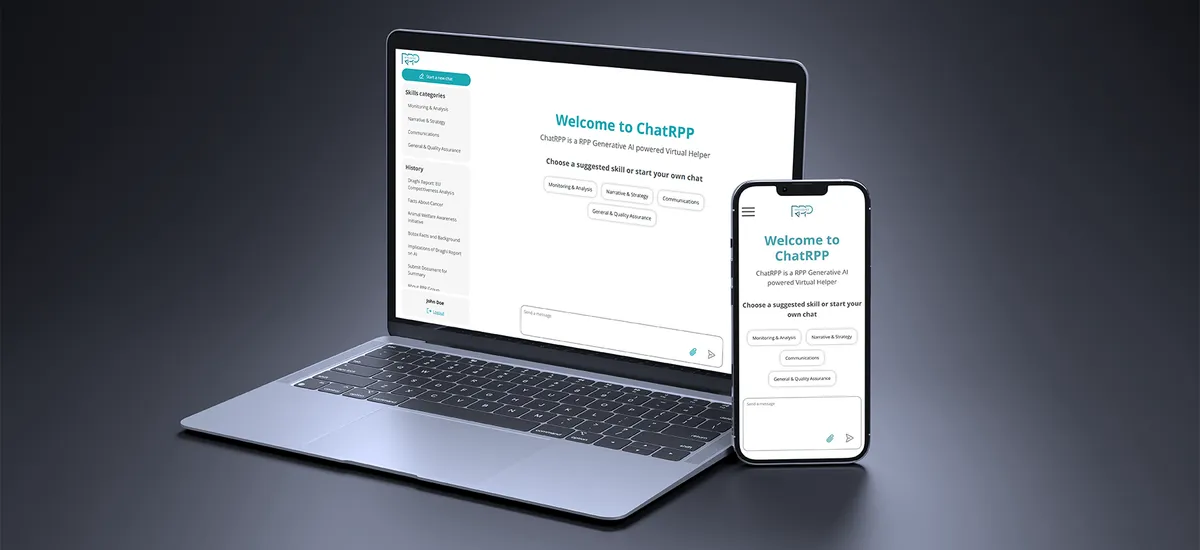
Public affairs · RPP Group
Senior consultants spent hours on document analysis, data structuring and drafting, work that crowded out the strategic side. ChatRPP now carries it, in the firm’s own tone and inside their own infrastructure.
Read the case studyHow to start
A service desk queue, a runbook collection or a data pipeline: the work your team does by hand today, and the data it runs on. We check early whether the data carries the use case and where it may be processed.
Tell us where the manual work sits and which data it involves. We come back within one business day with an initial assessment and a proposal for a 30-minute scoping call.
Describe your processWorkflows mapped, your data sources and requirements checked, and an architecture proposed with scope, timeline and cost. A standalone engagement with no commitment to proceed.
See the AI Discovery WorkshopFAQ
In technology and IT, AI takes over work that support staff and engineers otherwise do by hand: tickets in the service desk, answers for first-level support, incidents and anomalies in operations, AI features inside the product, unstructured data in pipelines, tenders and security questionnaires in presales, and documentation in engineering. The AI system prepares the result, and engineers and support staff decide.
Yes. A language model classifies each ticket by system, component and urgency and pulls out the relevant details. The assignment then follows rules you define, such as skills, availability and current workload. Your team sees why a ticket went where it went and can reassign it at any time.
Yes. For Policy-Insider.AI theBlue.ai built the entire technical platform, from proof of concept to a launched product with paying customers: collection and structuring of millions of political documents in several languages, analysis with NLP and large language models, and personal dashboards with AI-generated summaries in real time.
With an anonymisation API. For the data analytics company InSaaS.ai theBlue.ai integrated ShareMedix directly into the processing pipeline. It detects and masks names, addresses, phone numbers, IBANs and email addresses in text from very different sources, handles many concurrent requests and supports white lists, black lists and configurable rules.
Yes. Senior AI and ML engineers join your team for a task or a few months, as an extension of your team or as a specialised team, without a long-term commitment.
With one process, such as ticket classification for one queue, and the data behind it. The process analysis has a fixed price from €3k and ends with an architecture proposal that states scope, timeline and cost, including where the data may be processed. The build is priced in milestones, and first working components typically arrive six to eight weeks in.
Describe the process and we’ll come back within one business day with an initial assessment and a proposal for a 30-minute scoping call.