Clinical documentation
Anonymising patient documents
Discharge reports, doctors’ letters and findings are stripped of personal data on your own servers, while the clinical content stays readable.
Industries · Healthcare & MedTech
theBlue.ai builds custom AI systems for hospitals, clinics and MedTech companies. They take over manual work with clinical documents, medical images, product documentation, compliance paperwork and recurring questions from patients, staff and customers. Each one runs inside your existing infrastructure, on-premise wherever patient data requires it.
AI in healthcare reads medical text and images: it recognises details in reports, letters and forms, removes personal data and marks structures in MRI or CT scans.
In hospitals and at medtech companies this supports documentation, the preparation of findings and the processing of image data. Results go to the HIS, PACS or the company’s own application, often on the organisation’s own servers.
The gain: less typing, faster preparation and consistent anonymisation. The clinical judgement and every sign-off stay with the specialists.
Project example · Tirol Kliniken
Tirol Kliniken, the largest healthcare provider in western Austria, has to anonymise medical documents before they can be shared, archived or reused. Staff read every document, looked for the patient-identifying details and blacked them out one by one. Today ShareMedix, our anonymisation platform, runs the whole process on the hospital’s own servers.
Some of the organisations we have built for















What AI takes over
AI takes over manual work in clinical documentation, imaging, administration and patient communication, and in the compliance, support and quality work of MedTech companies.
Clinical documentation
Discharge reports, doctors’ letters and findings are stripped of personal data on your own servers, while the clinical content stays readable.
Clinical documentation
Findings, lab values and treatment notes from the patient record are pulled into a first draft, which the doctor checks, completes and signs.
Imaging
Bones, vessels and organs are outlined automatically for surgical planning, instead of slice by slice by hand.
Imaging
Findings that are easy to miss on a scan are marked for the radiologist or neurologist, who makes the assessment.
Administration
Diagnoses and procedures documented in the record are proposed as codes, and the coding team confirms or corrects them.
Patient communication
Questions about appointments, preparation and directions are answered from your approved information by chat or voice, and anything medical goes to staff.
MedTech compliance
Answers to questionnaires from hospital clients are drafted from your own policies, each with its source, for your team to verify.
MedTech support
Service and support staff ask in plain language and get an answer from manuals and product documents, with the source.
Quality management
Incoming complaints and reports from the field are sorted by product and topic and summarised for the quality team.
How it works
We report on Mrs Anna Berger, born 14 May 1958, residing at Lindenweg 12, Innsbruck, insurance no. 1234 140558.
The patient was admitted with community-acquired pneumonia and treated with intravenous antibiotics. Discharge in good general condition.
We report on [PATIENT], born [DATE], residing at [ADDRESS], insurance no. [ID].
The patient was admitted with community-acquired pneumonia and treated with intravenous antibiotics. Discharge in good general condition.
Illustrative example with invented data, based on the Tirol Kliniken case study.
Testimonials
Healthcare · Hospital operations
The growing need for anonymization had become a time-consuming manual process. Together with theBlue.ai, we were able to transform this challenge into an efficient, AI-powered process, significantly reducing manual effort and relieving the burden on our staff.
MedTech · Compliance
Managing the completion of security questionnaires is no longer a logistical nightmare. The new system is easy to manage and ensures our responses are accurate and comprehensive.
Built for healthcare requirements
In healthcare, three questions decide an AI project: where the data goes, how the result can be traced and who signs it off.
At Tirol Kliniken the system runs on the hospital’s own servers, without cloud and without a GPU, so the patient documents stay inside the hospital.
For apoQlar’s segmentation models, datasets, training and evaluation are fully documented and reproducible on Azure ML, so every model can be traced back to its data.
Staff review edge cases through a web interface, and every correction feeds back into the model. Clinical and regulatory decisions stay with your team.
The epilepsy lesion model for Evangelisches Krankenhaus Alsterdorf is prospectively validated in clinical practice and published in the peer-reviewed journal Epilepsy Research in 2021 and 2024.
Case studies
Three more healthcare projects: image segmentation for a MedTech company, lesion detection published in a peer-reviewed journal, and a voice assistant at a surgical congress.

MedTech · apoQlar
Before every surgery someone outlined anatomical structures on MRI and CT scans by hand, slice by slice. AI models now do it automatically.
Read the case study
Healthcare · Ev. Krankenhaus Alsterdorf
Neurologists scanned brain MRIs visually for epilepsy-causing lesions, which takes expert knowledge and can miss subtle cases. Our models detect them with higher sensitivity than the eye, and the results are published in the peer-reviewed journal Epilepsy Research.
Read the case study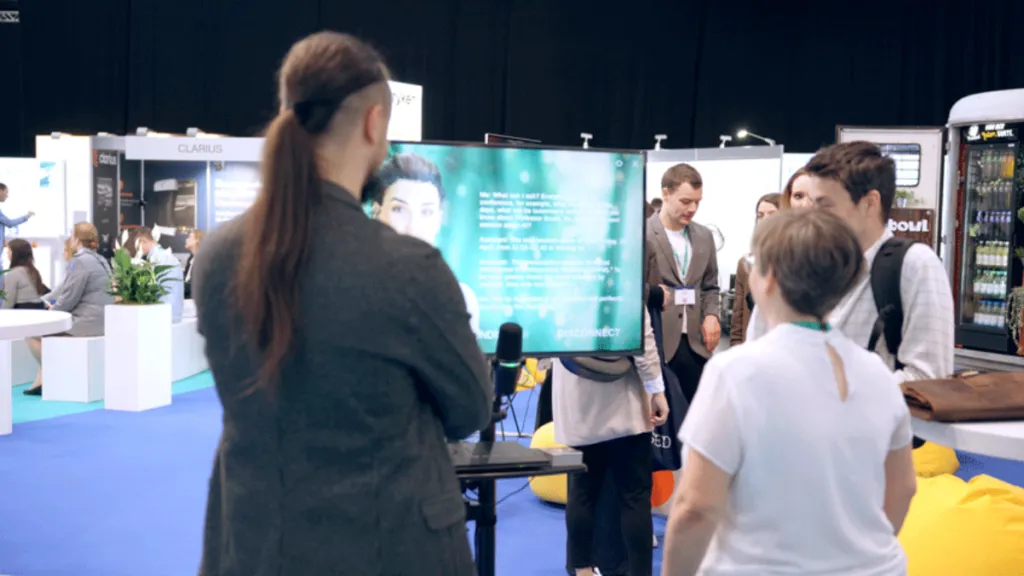
Healthcare · German Congress of Surgery
At Germany’s largest surgical congress, attendees asked staff the same navigation and scheduling questions all day. A voice assistant took those over.
Read the case studyHow to start
A process that costs your team the most time, and the documents or images it runs on. We check early whether the data carries the use case and where it may be processed.
Tell us where the manual work sits and which data it involves. We come back within one business day with an initial assessment and a proposal for a 30-minute scoping call.
Describe your processWorkflows mapped, your data and privacy requirements checked, and an architecture proposed with scope, timeline and cost. A standalone engagement with no commitment to proceed.
See the AI Discovery WorkshopFAQ
In healthcare and MedTech, AI takes over work that clinical and product teams otherwise do by hand: anonymising and drafting clinical documents, segmenting MRI and CT images, preparing coding, answering recurring patient questions, and handling compliance questionnaires, product documentation and complaints in MedTech companies. The AI system prepares the result, and clinicians and qualified staff decide.
Yes. At Tirol Kliniken the anonymisation system runs entirely on the hospital’s local servers, with no cloud, and it works on standard hospital hardware without a GPU. theBlue.ai deploys on-premise, in the cloud or hybrid, and for patient data the on-premise route means the documents never leave the building.
Models trained on medical language identify patient-identifying information in discharge reports, doctors’ letters and findings, such as names, dates, addresses and insurance numbers, and remove it while the clinical content stays readable. At Tirol Kliniken staff review edge cases through a web interface, every correction feeds back into the model, and the manual anonymisation workload was eliminated.
For focal cortical dysplasias, a common cause of drug-resistant epilepsy, it can support the specialists. The 3D neural network theBlue.ai built with Evangelisches Krankenhaus Alsterdorf reaches 90 percent sensitivity at 70 percent specificity, higher sensitivity than conventional visual analysis, and the results are published in the peer-reviewed journal Epilepsy Research.
By letting a retrieval system draft answers from the company’s own policies and documentation, with a source for every answer. For apoQlar, security questionnaires from hospital clients used to take eight to ten people about a month. A GenAI assistant now drafts the responses and a small team verifies them, which cut completion time by 75 percent and saves an estimated $90,000 a year.
With one process, such as anonymising one document type or answering one recurring questionnaire, and the data behind it. The process analysis has a fixed price from €3k and ends with an architecture proposal that states scope, timeline and cost, including where the data may be processed. The build is priced in milestones, and first working components typically arrive six to eight weeks in.
Describe the process and we’ll come back within one business day with an initial assessment and a proposal for a 30-minute scoping call.