News & Events · ML Con
From voice agents to adaptive systems: a look back at ML Con New York
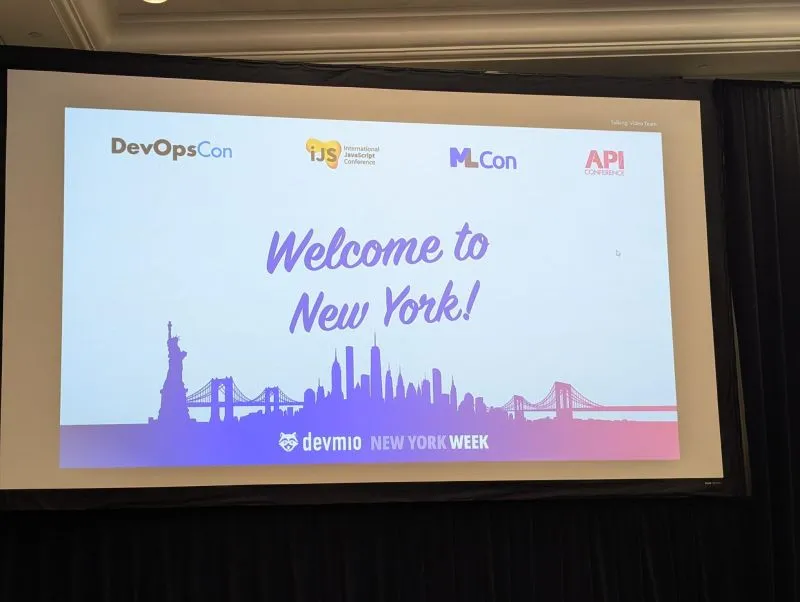
Four conferences under one roof, a packed afternoon and two very different applications of AI. Agata Chudzińska, CTO of theBlue.ai, gave two talks at ML Con by devmio at the New York Marriott at the Brooklyn Bridge this September. Both come down to the same question: how do you take an AI system from the demo to daily operation, where it has to work quickly, reliably and adaptively?
 Julia Rose
Key takeaways
- On 29 September 2026 Agata Chudzińska gave two talks back to back at ML Con in New York, at the New York Marriott at the Brooklyn Bridge.
- The first covered delays in voice agents: where they come from and why averages hide the problem.
- The second used a case from MRI diagnostics to show how a model keeps learning from new data without losing what it knew.
- Both lead to the same conclusion: adaptability is a design decision, not something added later.
Talk 1: Voice Agents, Where Latency Hides and How to Fight It
Text-based AI agents can afford a degree of sluggishness. Voice-based systems are held to a different standard. Between two people in conversation the gap averages 208 milliseconds, measured across ten languages on five continents. Anyone talking to a machine expects that same rhythm. In practice, delays hide in every single layer of the stack.
The talk sorted them into three engineering problems.
- Detecting the end of a turn. Silence does not mean the end of a sentence. Whether someone is thinking, reading out a sequence of digits or correcting themselves (“I want to go to, um, Penn Station, no, Grand Central”), a simple timer based on silence falls short. Current approaches use models that predict from syntax and prosody whether a thought is complete.
- Choosing the right transport. Classic HTTP over TCP carries too much overhead for a conversation. For real time the picture today is: WebRTC on the first hop between device and your own infrastructure, WebSocket between your own services, SIP for the phone network.
- Interruptions. When the caller cuts in, stopping the audio is not enough. The system has to truncate the transcript to what the caller actually heard. Otherwise it refers later to sentences that never reached them.
The core point concerned measurement. If you build voice agents, do not rely on averages, and not on the median alone either. What matters is the tail of the distribution. A platform benchmark from August 2026 reached 1.73 seconds as its best median, with 3.19 seconds on one turn in twenty and 10.4 seconds on one in a hundred. If just one turn in twenty is slow, then across twenty turns per call 64 callers in 100 hit at least one long pause.
Talk 2: Building AI That Learns and Adapts
While voice agents are optimised for milliseconds, medical AI systems wrestle with a more fundamental machine learning problem: catastrophic forgetting.
The example came from epileptology, the detection of focal cortical dysplasia in MRI scans. The research was led by Dr Patrick House at the largest epilepsy centre in Germany. The talk used it to show how a neural network can adapt to shifting data distributions without erasing what it already knew.
When a model is updated with new data, after a change of scanner or with new kinds of findings, naive retraining often leaves it failing on the older cases. The obvious way out, training everything from scratch, runs into two limits in projects of this kind. First, all the old data has to still be there, which is rarely possible indefinitely with patient data. Second, every full run costs the same compute as the first, with the energy use that comes with it.
Continual learning is the name under which the research collects the remedies, and a striking number of them are borrowed from how the brain works. Regularisation methods such as Elastic Weight Consolidation identify the parameters that mattered for the earlier task and protect them from change. Replay methods keep a small selection of old examples and train them alongside the new ones. In the MRI project, sensitivity stayed at the same level while specificity rose considerably.
The closing section looked ahead. With large language models the same problem is unsolved, because such a model is built in several stages and each stage can overwrite what the previous one learned. The furthest-reaching proposal at present comes from Google Research and is called Nested Learning. There, training consists of several optimisation loops nested inside each other, some running fast and adapting, others running slowly and consolidating what should last. That too is borrowed from the brain.
We have described the MRI case in full, with the architecture, both versions of the model and the clinical results, in Building AI that learns and adapts.
A common denominator: adaptability as a design decision
Whether in the millisecond range for voice AI or across months of validation on medical imaging data, the lesson from New York is the same in both cases. Adaptability cannot be retrofitted. It is decided at design time.
Modern AI systems have to cope from the start with shifting conditions, with new data that looks different from the old, and with an answer that has to arrive within a given window. That four conferences ran together in New York, covering machine learning, DevOps, APIs and JavaScript, fits the picture. The place where low-level engineering meets machine learning is where the interesting questions currently sit.
How we scope this kind of work is described on How we work. More about the team on About us.
The figures come from the presentations and carry their sources there: Stivers et al., PNAS 106(26), 2009, for the human conversational rhythm, a platform benchmark by Cekura from August 2026 for the response times, van de Ven et al., 2024, for catastrophic forgetting, and Google Research for Nested Learning. On the event: ML Con by devmio.
Planning an AI project?
In the process analysis we map your workflows, rank the possible use cases by return and propose an architecture.
Request a process analysisFrequently asked questions
Two topics. The first talk on 29 September 2026 was called “Voice Agents: Where Latency Hides and How to Fight It” and covered delays in voice agents. The second, “Building AI That Learns and Adapts”, used a case from MRI diagnostics to show how a model keeps learning from new data.
Because silence in a conversation reads as a fault. Between two people the gap between question and answer averages 208 milliseconds. In a chat window the user can see that something is happening; on the phone they only hear nothing.
Catastrophic forgetting describes the effect where a neural network retrained on new data loses what it could do before. In medicine it shows up when a model is updated with new scans after a change of equipment.
Continual learning covers the methods that let a model learn incrementally without losing what came before. They include regularisation, such as Elastic Weight Consolidation, and replaying old examples from a small buffer. Many of these methods are modelled on how the brain works.
ML Con is a conference on machine learning and generative AI, run by devmio. The New York edition took place at the end of September 2026 at the New York Marriott at the Brooklyn Bridge, alongside three further conferences on DevOps, APIs and JavaScript.
Julia has been part of theBlue.ai since 2019 and has accompanied the development of AI applications in the enterprise environment since the company’s early days. In her role as Marketing Lead, she works closely with the engineering and consulting teams and makes complex technical topics understandable and accessible for decision-makers.
In her articles, she writes about practical experience from enterprise AI projects, as well as the challenges and opportunities of using AI in companies.