
News & Events · ML Con
ML Con Munich: Why the Future of AI Is Spatial
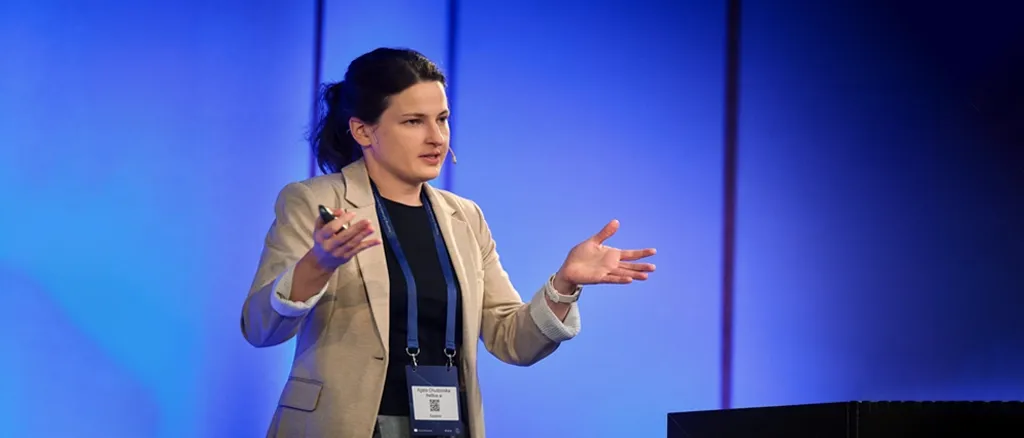
At ML Con Munich, Agata Chudzińska, CTO and AI Solutions Architect at theBlue.ai, spoke about World Models and Spatial Intelligence. Her thesis: the next AI breakthroughs will come from systems that understand space, dynamics, and cause and effect.
 Julia Rose
Key takeaways
- On 25 June 2026, Agata Chudzińska gave the keynote “From Language to Reality: Why the Future of AI Is Spatial” at ML Con in Munich.
- Scaling large language models on internet text is showing diminishing returns, and performance curves are flattening.
- World Models predict the next state of the world and learn through interaction, simulation and physical reasoning.
The keynote at ML Con
On 25 June 2026, Agata Chudzińska delivered a keynote at ML Con, held at the Holiday Inn Munich City Center. ML Con is the event for Generative AI and Machine Learning Engineering, bringing together developers, researchers and decision-makers who put AI into practice. The talk was titled “From Language to Reality: Why the Future of AI Is Spatial”.
Why language models are reaching a limit
At its centre is a thesis gaining weight across the AI community. After years of rapid progress, scaling large language models on internet text is beginning to show diminishing returns. Datasets are saturating and performance curves are flattening. A growing part of the research community is therefore turning to a broader paradigm rooted in the structure of the physical world.
World Models and Spatial Intelligence
Visionaries such as Fei-Fei Li and Yann LeCun argue that language alone does not produce genuine intelligence. That also takes perception, embodiment and the ability to model how the world evolves.
- World Models predict the next state of the world. They learn through interaction, simulation and physical reasoning.
- Spatial Intelligence describes the ability of AI systems to understand space, motion, and cause and effect.
The keynote explained the core ideas behind World Models, assessed the current state of Spatial Intelligence and showed why the next wave of breakthroughs is likely to come from systems that understand space, dynamics, and cause and effect.
What the shift means for developers and companies
For developers and researchers, the focus moves from ever larger language models towards models that learn from interacting with their environment. For companies, this becomes relevant wherever AI needs to understand movement, spaces or physical processes. One example from our work is 3D movement coaching, which captures rehabilitation exercises spatially and checks them in real time.
About Agata Chudzińska
Agata Chudzińska is CTO and AI Solutions Architect at theBlue.ai. She has led and delivered AI and data projects for many years, from early-stage startups to global corporations, connecting research with real-world application. Her passion lies especially with language, professionally in NLP applications and personally as a multi-language speaker. Read more about the team on our About us page.
About the event: ML Con, From Language to Reality: Why the Future of AI Is Spatial

Planning an AI project?
In the process analysis we map your workflows, rank the possible use cases by return and propose an architecture.
Request a process analysisFrequently asked questions
World Models are AI models that predict the next state of the world. They learn how an environment changes through interaction, simulation and physical reasoning.
Spatial Intelligence is the ability of AI systems to understand space, motion, and cause and effect. Researchers such as Fei-Fei Li see it as a precondition for genuine intelligence.
The thesis that scaling language models is reaching its limits and that the next breakthroughs will come from World Models and Spatial Intelligence. The keynote took place on 25 June 2026 at ML Con in Munich.
Julia has been part of theBlue.ai since 2019 and has accompanied the development of AI applications in the enterprise environment since the company’s early days. In her role as Marketing Lead, she works closely with the engineering and consulting teams and makes complex technical topics understandable and accessible for decision-makers.
In her articles, she writes about practical experience from enterprise AI projects, as well as the challenges and opportunities of using AI in companies.