
AI Architecture & Integration · Evaluation
LLMOps for Enterprises: Benchmarking and Comparing Vision LLMs
Which model works best for our use case? Anyone working with large language models keeps asking this, because models, prices and results change constantly. Add images as input and it gets more complex still. LLMOps brings structure to comparison, evaluation and operation.
 Aleksandra Osztynowicz
Key takeaways
- LLMOps manages the use of pretrained language models: prompts, context, evaluation and monitoring in production.
- Evaluation rarely compares against a single correct label. Relevance, coherence, correctness and safety need test sets, human judgement or LLM-as-a-judge.
- Many LLMOps tools are built for text. Vision models need versioned image datasets and adapted evaluation.
- Langfuse and Phoenix are a good foundation for reproducible comparisons and can be self-hosted.
How LLMOps differs from MLOps
Classic MLOps revolves around training your own models on clearly defined datasets with known correct results. With large language model applications, you usually start from a pretrained model and adapt it through prompts, context, retrieval or light fine-tuning. The central question becomes: how do we reliably get usable results from it?
| MLOps | LLMOps | |
|---|---|---|
| Starting point | train your own model | use and adapt a pretrained model |
| Levers | training data, features, hyperparameters | prompts, context, retrieval, model choice |
| Datasets | input with one correct result | realistic use cases, often with several valid answers |
| Evaluation | accuracy against labels | relevance, coherence, correctness, safety |
| Tools | experiment tracking, model registry | prompt versioning, tracing, evaluation, cost monitoring |
More on the classic approach in Ensuring reliable and scalable AI solutions with MLOps.
Prompts and evaluation
Prompt engineering is an ongoing process. Small changes in wording can produce very different results, and what worked last week may stop working after a model update or with slightly different input.
Evaluation is harder too. Good outputs are relevant, coherent, factually correct and safe. Criteria like these are hard to capture in a single number and need human judgement or a model that scores outputs against defined criteria (LLM-as-a-judge). Without prompt versioning and direct comparison of outputs, it is hard to tell whether a team is making progress.
Datasets here mostly serve evaluation. They consist of realistic examples that reflect actual use, sometimes with example outputs as context or full conversation histories.
What LLMOps tools cover
- Prompt versioning: manage, compare and trace prompts.
- Monitoring: track token usage, latency, cost and error rates.
- Tracing: follow multi-step flows and tool calls.
- Evaluation: assess outputs systematically with test sets, LLM-as-a-judge or human review.
Developers use these tools as much as product owners and quality assurance. How operation is monitored is covered in our article LLM observability and monitoring.
When images come in
Modern multimodal models process images as well as text. That opens up many business applications:
- detecting defects in product images
- estimating quantities or costs from photos
- verifying work steps from photo documentation
- processing documents with text recognition
- understanding spaces for navigation tasks
Many LLMOps tools, however, are optimised for text. Visual workflows usually need a mix of classic MLOps tools and adapted components for evaluation and monitoring. How well vision models perform in quality inspection is shown in our article LLMs in visual inspection and quality control.
A practical workflow for vision LLMs
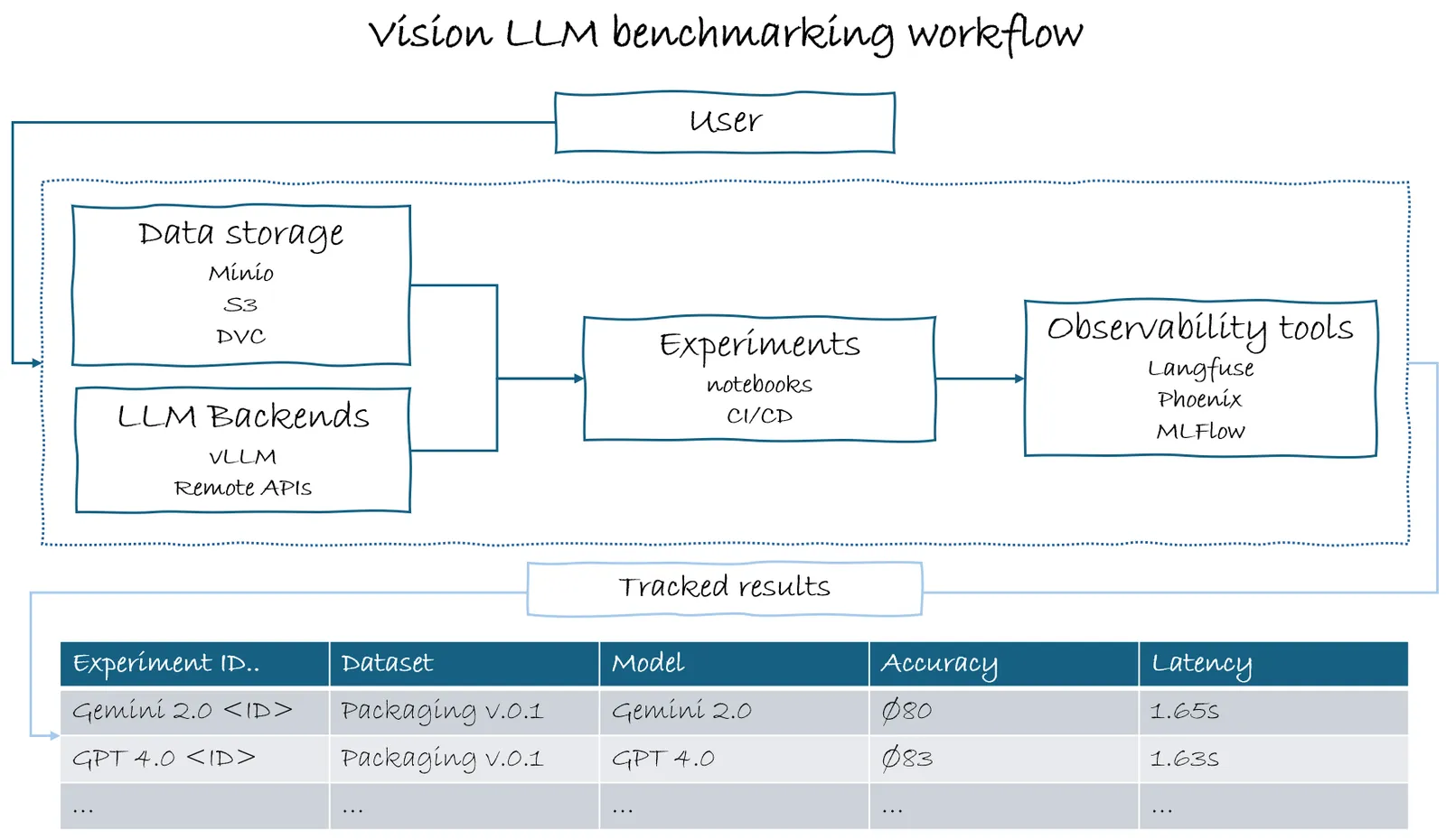
- Version the data: store image datasets in S3, MinIO or DVC with paths, metadata and version history so experiments stay comparable.
- Choose a model backend: self-hosted, for example with vLLM, or via cloud APIs. Each option has its own trade-offs in latency, cost and control.
- Run benchmarks: exploratory in notebooks first, later automated in CI/CD pipelines triggered by changes to model or dataset.
- Monitor metrics: token usage, response times and error rates, to spot performance issues and costs early.
- Use tracing: for RAG or agents, to follow flows and find sources of error.
- Evaluate outputs: with scoring, manual comparison or LLM-as-a-judge against clearly defined criteria.
- Document results: make comparisons, prompt changes and progress over time visible.
Example tools
- Langfuse supports experiment tracking, prompt versioning and reports on key metrics. It is open source and can be self-hosted.
- Phoenix by Arize manages datasets and experiments, visualises evaluations and offers tracing and prompt management. It is released under the Elastic License 2.0 and can run locally, in containers or in the cloud.
Both can be extended with custom logic for image-based workflows. That takes some configuration and provides a solid basis for reproducible evaluation.
How to get started
- Define the task and criteria: what should the model do, and how do experts recognise a good result?
- Build a test set: realistic examples, with versioned images for vision tasks.
- Compare several models: same data, same criteria, documented prompts.
- Automate: comparisons rerun with every change, complemented by monitoring in production.

Finding the right model for your use case?
We compare models on your own data with you and build an evaluation process that holds up after model updates.
Request a process analysisFrequently asked questions
The practice of developing and operating large language model applications in a structured way: versioning prompts, comparing models, evaluating outputs and monitoring cost, latency and errors in production.
MLOps focuses on training your own models on labelled data. LLMOps mostly works with pretrained models and steers their results through prompts, context and retrieval, evaluated on criteria such as relevance and correctness.
With versioned image datasets of realistic examples, fixed evaluation criteria, comparison of several models under the same conditions and automated benchmarks that rerun when something changes.
For example Langfuse for tracing, prompt versioning and reports, and Phoenix by Arize for datasets, experiments and evaluation. Both can be self-hosted.
Aleksandra has been building custom AI solutions at theBlue.ai since 2021, with a focus on agentic implementations and local LLM deployments that precisely fit enterprise needs. As an AI Engineer, she helps organizations automate their processes with production-grade systems, from on-premise open-source models to RAG-based internal knowledge bases for regulated industries, and continuously expands her knowledge in the rapidly changing world of artificial intelligence.
In her articles, she shares practical experience from real enterprise AI projects and shows that deploying AI in companies doesn’t need to be complicated.