IoT · Computer vision and edge AI
Counting people at the door, without sending anything to the cloud
Building and public transport operators need occupancy figures in real time, for safety compliance, capacity management and operational planning. Counting by hand is impractical across several entrances, and turnstiles are expensive or architecturally impossible. With RapidLab we built compact devices that count automatically from sensor data and computer vision, processing everything on the device.

Key results
Client: RapidLab
A specialist in intelligent electronics and IoT prototyping, serving building operators and public transport providers.

- Industry
- IoT, building and transit operations
- Use case
- Automated people counting
- AI approach
- Time-series ML and computer vision
- Hardware
- Time-of-flight sensors and video cameras
- Deployment
- Edge computing, on the device
- Environment
- Buildings, buses, trains
In short
A simple-sounding question that is hard to answer
- How many people are inside right now sounds simple. In practice buildings have several entrances, and a bus or train opens every door at once at every stop.
- Counting by hand does not scale, and turnstiles and barriers are expensive to install and often impossible in an existing layout.
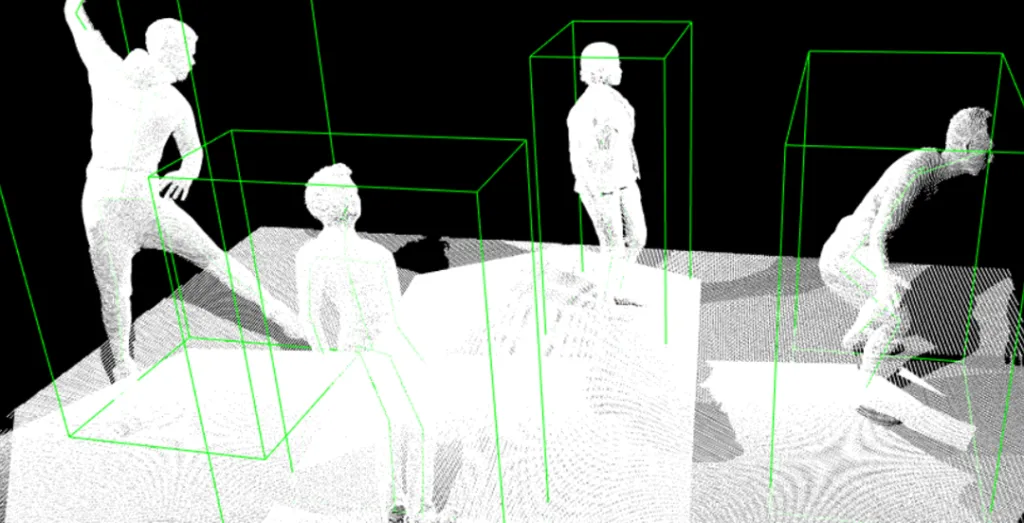
- The device counts people entering and leaving, in two variants: a lightweight time-of-flight sensor model for simpler doorways and computer vision where traffic is heavy and lighting varies.
- All inference runs on the device, so it works with no internet, with no latency, and with no video ever leaving the doorway.
The starting point
The challenge
Real-time occupancy tracking was either manual and impractical at scale, gate-based and expensive, or simply absent. Operators were making capacity and safety decisions without reliable data.
Knowing how many people are inside a building or a vehicle at a given moment sounds simple, and it is not. Buildings have multiple entrances and exits. Buses and trains open every door simultaneously at every stop.
Manual counting is impractical at any meaningful scale, and physical counting gates, turnstiles and barrier systems, are expensive to install and often impossible in an existing architectural layout.
The need became acute during the pandemic, when occupancy limits had to be enforced in real time. But the underlying problem is permanent: building operators, transit authorities and facility managers need accurate occupancy data for safety compliance, capacity planning and operational efficiency, and a manual process cannot deliver it.
The build
What we built
Working with RapidLab’s IoT hardware engineers, we developed the AI layer for a compact device that counts people entering and leaving, mounted at a doorway in a building or at a vehicle entrance on a bus or train.
Two approaches for two kinds of doorway
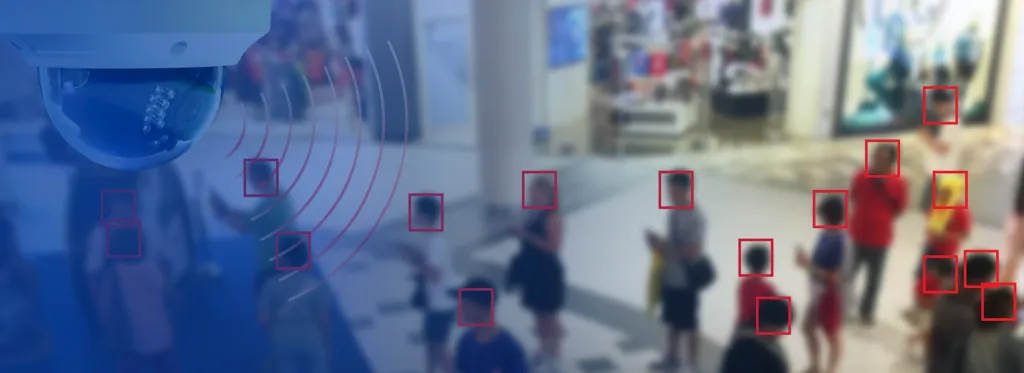
We built two versions. The first uses time-of-flight sensor data with machine learning on time-series patterns, which is lightweight and enough for simpler environments. The second uses video with deep learning computer vision, which holds up where several people pass at once or the lighting changes.
Nothing leaves the device
All inference runs on the device itself; no video and no sensor data goes to the cloud. That was deliberate, for three reasons: real-time response without network latency, deployment in places with no internet at all, and privacy, because no personal footage ever leaves the doorway.
Finding the architecture that fits the hardware
The project involved defining the data collection protocols, exploring the sensor patterns, and iterating quickly through neural network architectures to find the balance between accuracy and what edge hardware can actually compute.
Small enough to fit anywhere
The result is a small device mounted at any doorway: no construction work, no turnstiles, no architectural modification. That is what makes deployment across hundreds of locations or vehicles economically viable.
What changed
The results
Before
Manual headcounts, expensive physical gates, or no occupancy data at all. No real-time view of how many people are in a space.
After
Automated real-time counting on compact edge devices. No cloud dependency, no architectural modification, deployable across buildings and whole transport fleets.
Operators get accurate real-time occupancy without the cost and the constraints of physical counting infrastructure.
Counting runs continuously and automatically: no staff involvement, no internet connection, and no privacy question, because the video never leaves the device.
Beyond safety and compliance, the data feeds operational planning: peak usage patterns, staffing, and capacity decisions based on actual numbers rather than estimates.
Questions about this project
Automated people counting. Real-time occupancy tracking was either manual and impractical at scale, gate-based and expensive, or simply absent. Operators were making capacity and safety decisions without reliable data.
All processing on the device, no cloud and no internet needed: Edge AI. Time-of-flight sensor ML and computer vision deep learning: 2 modes. Live occupancy across every entrance and exit: Real time. A small device for buildings and for vehicles: Compact.
Time-series ML and computer vision. Technology used: Computer vision, Deep learning, Time-of-flight sensors, Time-series ML, Edge AI, Neural network optimisation, IoT integration.
Technology used
Talk to the people who built this
theBlue.ai comes back within one business day.