Manufacturing and IoT · Predictive maintenance
Knowing what an elevator is doing without going to look
An elevator manufacturer needed the real-time position and state of units in the field, information that until then existed only through a manual inspection or a service call. With an IoT partner we built ML models that read location and state from a deliberately minimal sensor set, and that keep working where the connection does not.

Key results
Client: Elevator manufacturer (under NDA)
An elevator manufacturer, delivered in partnership with an IoT hardware company. The manufacturer is under NDA, so it is not named here.
- Industry
- Manufacturing
- Use case
- Elevator position and state detection
- AI approach
- Clustering with custom domain logic
- Data
- IoT sensor data, minimal sensor set
- Constraint
- Limited connectivity, offline capable
- Goal
- A foundation for predictive maintenance
In short
Three constraints that ruled out the obvious approach
- Elevator maintenance has been schedule-based: technicians inspect at fixed intervals regardless of the unit’s actual condition. The manufacturer wanted to dispatch service only when it is needed.
- That starts with a hard technical problem, and it came with three constraints. An elevator shaft acts as a Faraday cage and disrupts wireless connectivity, so cloud connections drop unpredictably.
- The sensor set had to stay minimal, because instrumenting thousands of units heavily is not economical.
- And there was no labelled ground truth to train on, so the models learn the patterns directly from raw sensor readings.
The starting point
The challenge
The manufacturer had no automated way to know what their elevators were doing in the field. Manual inspection was the only source of status information, which is expensive, infrequent and reactive, and the physical environment made even basic connectivity a challenge.
Elevator maintenance has traditionally been schedule-based: technicians inspect units at fixed intervals regardless of actual condition. The manufacturer wanted to move to predictive maintenance, using real-time data to detect an anomaly early and dispatch service only when it is needed. Across a large building portfolio that means fewer unnecessary visits, less downtime and lower cost.
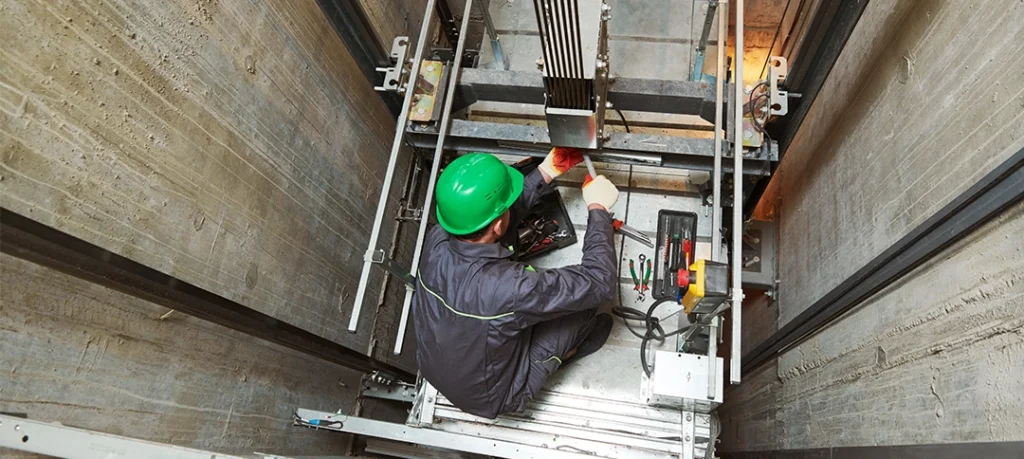
The first step was determining the position and operational state of an elevator from sensor data, and the constraints were significant. Elevator shafts create a Faraday cage effect that disrupts wireless connectivity, so cloud connections drop or delay unpredictably.
The solution had to work with minimal sensors to stay economically scalable across thousands of units. And there was no labelled ground truth data to train on: the system had to learn the patterns from raw readings.
The build
What we built
Alongside an IoT partner who handled the hardware and the device design, we took the data and intelligence layer: turning raw sensor signals into information someone can act on.
Deciding what to collect in the first place
We designed the collection approach from scratch: what to capture, how to structure it, and how to turn noisy sensor readings into usable datasets. That included handling the gaps and delays that intermittent connectivity in a shaft produces.
Position and state, without labels
Clustering algorithms enhanced with custom domain logic determine the current floor and the operational state, moving up, moving down, idle, door open, door closed, from minimal inputs. Because there was no ground truth, the algorithms learn the patterns directly from the data.
It keeps working when the connection stops
The architecture processes and stores locally when cloud connectivity is unavailable and syncs once the connection returns. In a real deployment, where shafts routinely block wireless signals, anything else stops working the day it is installed.
Few enough sensors to fit a whole fleet
The approach is optimised for the fewest possible sensors per elevator, because instrumenting every unit in a large fleet heavily is not economical. We showed that meaningful operational intelligence comes out of a deliberately constrained sensor set, which is what makes fleet-wide deployment viable.
What changed
The results
Before
No automated visibility into elevator status. Schedule-based maintenance, reactive service calls, and no data infrastructure at all.
After
Automated position and state detection from sensor data, an offline-capable architecture, a minimal sensor footprint, and the foundation for predictive maintenance.
The project delivered the collection, processing and ML infrastructure needed to understand elevator behaviour in the field, which is the layer predictive maintenance sits on.
The manufacturer gained automated visibility into operations that had previously existed only through a manual inspection.
Extracting usable intelligence from minimal sensors, in a connectivity-constrained environment, without labelled training data, is work inside real industrial constraints rather than clean lab conditions.
Questions about this project
Elevator position and state detection. The manufacturer had no automated way to know what their elevators were doing in the field. Manual inspection was the only source of status information, which is expensive, infrequent and reactive, and the physical environment made even basic connectivity a challenge.
Built for the fewest possible sensors, so a whole fleet stays affordable: Minimal. Works where connectivity fails, inside the shaft’s Faraday cage: Offline. Clustering with custom logic for state and position: ML. The foundation for predictive maintenance at scale: PdM.
Clustering with custom domain logic. Technology used: Machine learning, Advanced clustering, IoT sensor data, Offline architecture, Data pipeline design, Unsupervised learning, Predictive maintenance.
Technology used
Talk to the people who built this
theBlue.ai comes back within one business day.