
LLMs & AI Agents · Agentic AI
AI Agents 2026: From Chatbots to Autonomous Digital Employees
In 2026, AI agents are more than chatbots with better prompts. They break goals into steps, call tools, operate software and run workflows partly on their own. Whether that becomes a productivity lever is decided by integration into processes, systems and control mechanisms.
 Julia Rose
Key takeaways
- Gartner counts agentic AI among the strategic technology trends, but warns of “agent washing” and expects over 40% of projects to be scrapped by the end of 2027.
- Agents help where workflows recur but are not always identical: unstructured inputs and data spread across several systems.
- What matters now is tool integration, efficient handling of context and robust infrastructure with rate limits, retries and budgets.
- Agents run stably with minimal permissions, defined actions, traceable calls, human approval and ongoing tests.
Analysts classify agentic AI as a strategic trend. At the same time they warn of “agent washing”, meaning plain chatbots marketed as agents, and of many abandoned projects when cost, value and governance are not clearly defined. According to Gartner, over 40% of agentic AI projects will be scrapped by the end of 2027.
Sources: Gartner, Top 10 Strategic Technology Trends for 2025; Reuters, Over 40% of agentic AI projects will be scrapped by 2027, Gartner says
Practice shows a clear pattern. The model matters, and for complex tasks such as coding or long contexts there are measurable differences between Claude, GPT, Gemini and others. But once agents receive real system permissions, architecture matters more than the model name: tool integration, clean processes, monitoring and security rules.
Where AI agents are used today
AI agents work mainly where workflows recur but do not always run the same way. Typical are unstructured inputs such as emails, PDFs or support tickets, combined with data from several systems. They are especially helpful when they connect systems, consolidate information and document their steps transparently, because that reduces review effort.
- Customer service: sorting requests, pulling context from CRM or knowledge systems, preparing answers and executing defined actions such as ticket updates.
- DevOps and software development: analysing issues, proposing code changes, running tests and preparing pull requests for human review.
- Office and knowledge work: automating email sorting, spreadsheet workflows, research and reporting, via APIs or, where there are none, via the user interface.
An important maturity marker is access to production systems. As long as agents only make suggestions, the risk is manageable. Once they receive real permissions in ERP, CRM or ITSM systems, access management, traceability, security mechanisms, cost control and clear handovers to people move to the centre.
In practice: RPP Group
For the public affairs consultancy RPP Group, five specialised agents work under one orchestrator, from document analysis to drafting. Time spent on manual routine work fell by around 70%, and confidential data stays in the firm’s own infrastructure.
What vendors show: the example of Claude
Anthropic’s model Claude is often cited in the agentic AI context because Anthropic publicly documents many features and technical details. With “computer use”, Claude can see and operate screen interfaces, clicking, scrolling and typing. Anthropic explicitly notes that the feature is experimental and should not be used in production without safeguards.
In software development a typical flow emerges: an issue goes to the agent, it works, tests run, the result is prepared and a person reviews it. Evaluations such as METR’s show that agents partly solve many complex tasks but do not reach stable end-to-end autonomy without clear tool structures, security rules and human oversight. Claude stands for a market development here, and similar concepts exist at other vendors.
Sources: Anthropic, Introducing computer use; METR, Claude 3.5 Sonnet Evaluation Report
The most important technical developments
The decisive progress in 2026 concerns better systems around the model.
Tool integration as a core principle
Production agents need clearly defined interfaces to read data and execute actions. OpenAI and Google are therefore building out their offerings into full agent stacks with monitoring and governance functions. One trend is standardising such interfaces, for example through the open Model Context Protocol (MCP), which connects models securely to data sources. The direction is clear: structured tool contracts instead of loose integrations. Our article how to connect AI to enterprise tools explains how function calling, MCP and code execution work together.
Context and efficiency
When many tools are connected at once, context grows quickly. That raises cost and can affect stability. Dynamic tool loading and code execution outside the model are therefore gaining importance: the model loads only the tools it needs and processes data in an execution environment.
Infrastructure and operations
Agents often run many steps in sequence, which means more API calls and higher load. Rate limits, meaning limits on how often an API may be used, retry strategies, queues and budget controls therefore belong in the system design. Without monitoring, logs and tests, an agent cannot run stably.
Sources: OpenAI, New tools for building agents; Google Cloud, Vertex AI Agent Builder; Anthropic, Introducing the Model Context Protocol; Anthropic, Code execution with MCP; OpenAI, Rate limits
Where the limits are
Agentic AI in 2026 is powerful but not fully autonomous. Many risks arise less in the model than in the system architecture:
| Typical problem | Countermeasure |
|---|---|
| Errors in long chains of steps | Check interim results, split tasks into smaller steps |
| Wrong assumptions or hallucinations | Tie answers to sources, human approval for critical actions |
| Tool failures from API or UI changes | Defined interfaces, regular tests, monitoring |
| Infinite loops | Step limits and abort rules in the orchestrator |
| High cost on long runs | Budget limits, efficient context, suitable model choice |
Without clear rules, monitoring and tests, an agent will not scale reliably.
Why integration now decides
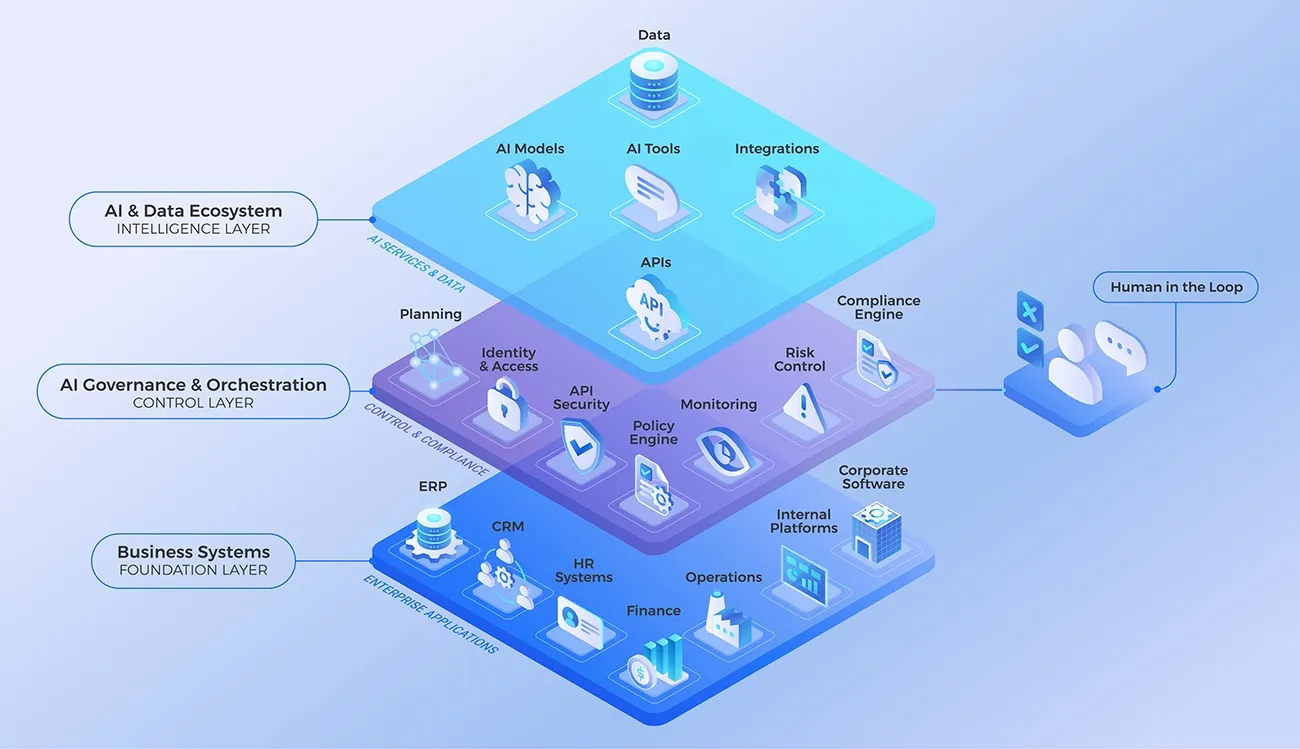
Agentic AI becomes a productivity lever when it is treated like business-critical software: with clear system boundaries, defined interfaces, controlled permissions, monitoring, tests and data protection.
A proven architecture pattern separates the orchestrator, the tool layer and the target systems. The agent does not write directly into an ERP system but calls defined actions through a controlled layer, comparable to “action groups” in Amazon Bedrock. Key principles are:
- minimal permissions,
- clearly defined actions,
- traceable tool calls,
- human approval for critical changes,
- regular tests
- and transparent cost control.
Source: AWS, Action groups for Amazon Bedrock agents
In practice: Radaway
At Radaway, an LLM system processes email orders largely automatically. Cases it cannot process reliably are routed to employees. Manual intervention in order entry fell by around 90%.
Conclusion
Agentic AI becomes a strategic topic in 2026 and goes far beyond classic chatbots. Its performance depends on the model, its stability and scalability mainly on integration, architecture and governance. Agents embedded like business-critical software in processes, system landscapes and control mechanisms create scalable value.
The fastest, lowest-risk way there is a clearly scoped proof of concept: one concrete process, real system integration, defined KPIs for time, quality and cost, and a clean permission and approval model. Our AI agent development page shows how we build and integrate agent systems.

Putting AI agents into production?
In the process analysis we choose a concrete process with you, clarify system integration, KPIs and approval model, and deliver a proposal with architecture, timeline and cost.
Request a process analysisFrequently asked questions
A chatbot answers questions. An AI agent breaks a goal into steps, calls tools, works with software systems and runs workflows partly on its own.
Marketing plain chatbots or simple automations as AI agents. Gartner warns about it alongside its forecast that over 40% of agentic AI projects will be scrapped by the end of 2027.
Often because of rising costs, unclear value and missing security rules. Technically, errors in long chains of steps, tool problems and missing monitoring add to that.
With minimal permissions, clearly defined actions through a controlled tool layer, traceable calls, human approval for critical changes, regular tests and cost control.
Julia has been part of theBlue.ai since 2019 and has accompanied the development of AI applications in the enterprise environment since the company’s early days. In her role as Marketing Lead, she works closely with the engineering and consulting teams and makes complex technical topics understandable and accessible for decision-makers.
In her articles, she writes about practical experience from enterprise AI projects, as well as the challenges and opportunities of using AI in companies.