
AI Architecture & Integration · Multi-agent
Multi-Agent Systems: Architecture, Integration, and Governance
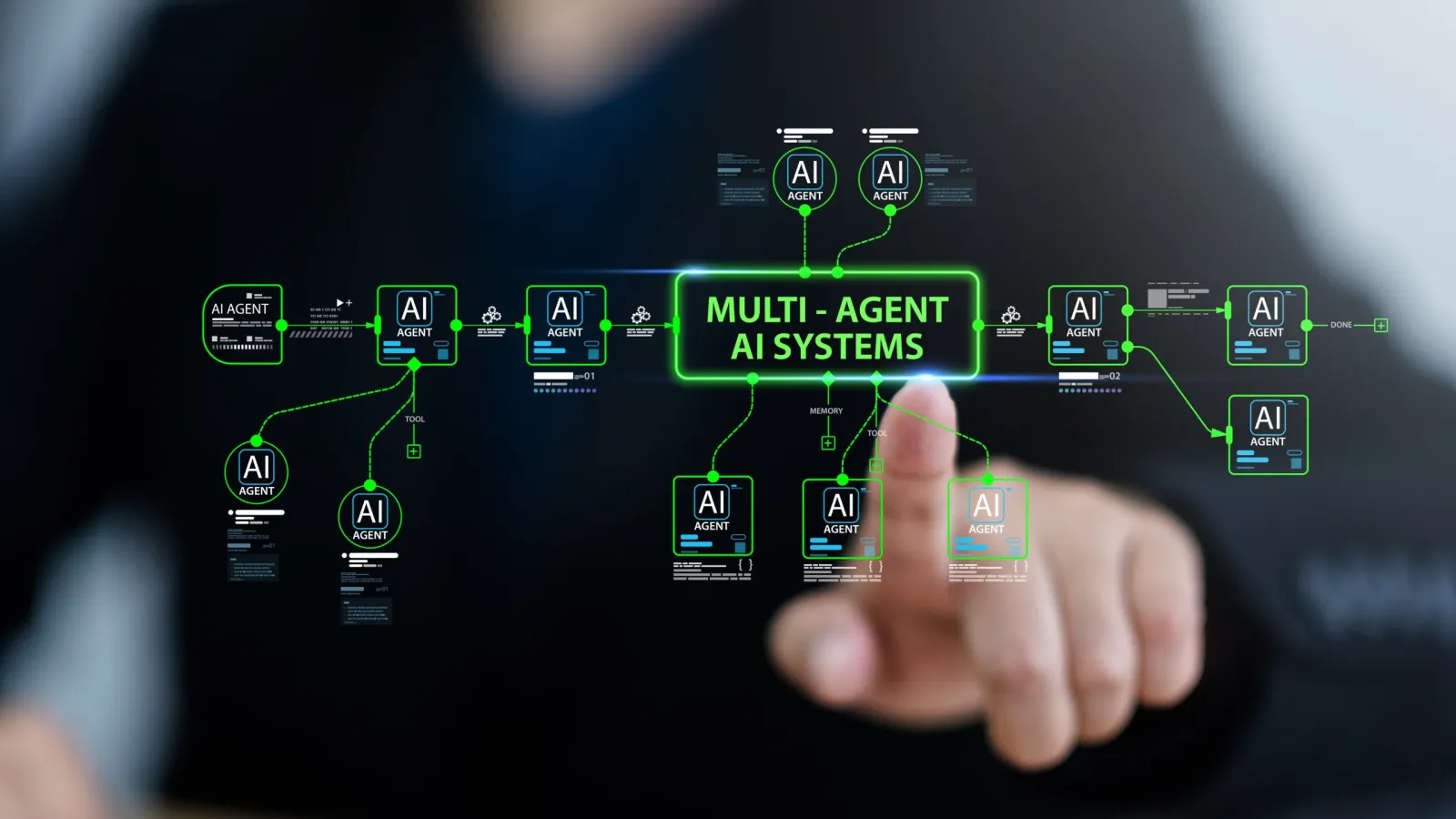
In a multi-agent system, specialised AI agents share a business process: one gathers data, one assesses risk, one produces documents, and a coordinator steers the whole. Whether that holds up in production depends mainly on the infrastructure underneath: protocols, integration and governance.
 Aleksandra Osztynowicz
Key takeaways
- Gartner lists multi-agent systems among the strategic technology trends for 2026. According to McKinsey, 62% of organisations are experimenting with AI agents and 23% are already scaling them.
- MCP connects agents to data and tools, A2A governs communication between agents. Hybrid architectures combine control and robustness.
- The biggest hurdle is usually integration with ERP, CRM and archives, rarely the model.
- For 75% of leaders, security, compliance and auditability are the most critical requirements for deploying agents (KPMG).
From a single agent to a multi-agent system
Many companies are still working on the best prompt for their chatbot. The real development lies elsewhere: in the autonomy of entire processes. Classic generative models answer on demand. Agentic systems act towards a goal, choose their own tools, check intermediate results and correct their course when the data changes.
A single agent takes on a defined task, such as analysing a contract or classifying a document. Real value creation, though, usually consists of many interlocking steps, whether in production planning or claims handling. In a multi-agent system, one agent gathers the data, a second assesses the risks, a third produces the documents, and a coordinator oversees the process and combines the decisions. Context is handed over, intermediate results are checked, and exceptions are escalated to people when needed.
In practice: citizen chatbot
For a Polish public authority we built a chatbot backed by eleven domain agents, one per knowledge area. Citizens ask in everyday language, and the system itself matches the question to the right agent and the technical documentation, with no category to pick.
What Gartner, McKinsey and KPMG observe
- Gartner lists multi-agent systems among its top ten strategic technology trends for 2026: they divide work among task-specialised agents, boosting efficiency and innovation. AI security platforms are on the same list.
- McKinsey reports in its 2025 global survey that 62% of respondents’ organisations are at least experimenting with AI agents, and 23% are already scaling agentic systems in at least one area.
- KPMG sees 2026 as the year agents arrive in the enterprise. For 75% of the leaders surveyed, security, compliance and auditability are the most critical requirements for that.
Sources: Gartner, Top Strategic Technology Trends 2026; McKinsey, The State of AI 2025; KPMG, AI Quarterly Pulse Q4 2025
Architecture: protocols, patterns and memory
The performance of a multi-agent system now depends more on its architecture than on the chosen language model. Beneath the visible workflows, communication and integration layers govern data flow, context handover and responsibilities.
Protocols
- Model Context Protocol (MCP) connects agents to internal data sources and tools.
- Agent2Agent (A2A) governs collaboration between agents across platforms. The Agent Communication Protocol (ACP) developed by IBM merged into A2A under the Linux Foundation in August 2025.
Source: LF AI & Data, ACP Joins Forces with A2A
Our article How to connect AI to enterprise tools explains in detail how MCP, function calling and code execution work together.
Three architecture patterns
| Pattern | Strength | Weakness |
|---|---|---|
| Centralised | One master agent, high controllability | Critical dependency on the master |
| Decentralised | Peer-to-peer, high resilience | Demanding monitoring and debugging |
| Hybrid | Targeted control and robustness | More planning at design stage |
In enterprise practice, hybrid models are increasingly prevailing.
Memory and context
An often underestimated building block is memory and context management. Production systems need short-term working memory for ongoing tasks and persistent knowledge layers for company and customer history. Structured memory architectures make agent behaviour traceable and safer. Without clean context logic, even the best model stays fragile in operation.
Integration: the real hurdle
A multi-agent system is only as good as the data it can reach. It has to access ERP and CRM systems, archives and external APIs at the same time, in real time, auditably and at scale.
That raises a fundamental decision: is data replicated, or do agents use it directly at the source through standardised connectors? Access at the source reduces complexity and security risk and simplifies governance.
Our project experience is clear: initiatives rarely fail on model logic and often on fragmented data landscapes. Multi-agent systems expose technical debt that has long been tolerated and demand consistent interfaces. Anyone introducing agents should therefore start with the data infrastructure. Our article The model is rarely the problem shows how AI connects to existing systems.
Governance: responsibility for autonomous systems
The more autonomously a system acts, the heavier the responsibility for it. Agents prepare or execute decisions with financial, legal and reputational consequences. Governance therefore belongs in the architecture.
Salesforce warns of a “trust bubble”: when agents act independently and across organisational boundaries, new questions arise around visibility, coordination, accountability and trust. Their decision logic must be verifiable at all times, conflicting objectives between agents detected and unwanted interactions prevented.
Source: Salesforce, Multi-Agent AI Is Coming Fast. Here’s How to Prepare
Regulatory pressure comes from two sides. The EU AI Act and the GDPR require transparency and risk classification, and sector rules such as DORA in finance add demands on operational resilience. Internal systems and pilots are covered too once they are used as high-risk AI. For stand-alone high-risk systems, these obligations apply from 2 December 2027. Our article on the EU AI Act gives an overview.
Assessing costs and benefits realistically
The costs of a multi-agent system arise less from the model licence than from architecture design, connecting legacy systems and building robust governance. The initial phase in particular is often underestimated: it takes months until proprietary systems are securely connected and security architectures are stable. Token-based pricing also carries a scaling risk, because what seems predictable in a pilot can grow hard to forecast with broad use.
Published success stories are usually based on a single company’s data and do not transfer easily. Check ROI claims for causal attribution and a realistic measurement period.
Where architecture, integration and governance are implemented cleanly, multi-agent systems reduce process exceptions, shorten lead times and remove structural sources of error. At RPP Group, five specialised agents cut time spent on routine work by 70%.
Conclusion: a strategic infrastructure decision
Multi-agent systems are a decision about a company’s infrastructure. Their value comes from the quality of the architecture, the depth of integration and the rigour of governance. Building them as an orchestrated, controlled process architecture creates lasting operational leverage.
The decisive question for 2026 is therefore whether an organisation is structurally ready to bring such systems into its core processes responsibly and securely. We support that from the first pilot to deep system integration; find out more on our multi-agent development page.

A multi-agent system for your processes?
We work out with you which process suits several agents, which systems need connecting and what governance and operations look like.
Request a projectFrequently asked questions
A multi-agent system consists of several specialised AI agents that work on a process together. A coordinator assigns tasks, hands over context and combines the results, while individual agents gather data, assess risks or produce documents, for example.
The Model Context Protocol (MCP) connects agents to data sources and tools, and Agent2Agent (A2A) governs communication between agents. IBM’s Agent Communication Protocol merged into A2A in 2025.
Mostly on integration: agents cannot reach data in ERP, CRM and archives consistently or in real time. Missing governance and underestimated costs in the initial phase add to that.
Centralised models with a master agent are easy to control but depend on the master. Decentralised models are more resilient but harder to monitor. In practice, hybrid architectures that combine both are prevailing.
Aleksandra has been building custom AI solutions at theBlue.ai since 2021, with a focus on agentic implementations and local LLM deployments that precisely fit enterprise needs. As an AI Engineer, she helps organizations automate their processes with production-grade systems, from on-premise open-source models to RAG-based internal knowledge bases for regulated industries, and continuously expands her knowledge in the rapidly changing world of artificial intelligence.
In her articles, she shares practical experience from real enterprise AI projects and shows that deploying AI in companies doesn’t need to be complicated.