
Healthcare · Congress operations
Four days of visitor questions, answered by speaking
The 141st Congress of the German Society of Surgery runs four days with hundreds of parallel sessions, thousands of attendees and a packed exhibition floor. Finding the right session, checking a schedule change and navigating the venue fell to information desks that could not keep up at peak hours. We deployed an assistant that handled those questions in real-time voice conversation, on a large screen kiosk and in VR.

Key results
Client: German Society of Surgery
The 141st Congress of the German Society of Surgery, DCK 2024, at the Leipzig Congress Centre from 23 to 26 April 2024.
- Industry
- Healthcare and congress operations
- Use case
- Automated session guidance and visitor support
- AI approach
- LLM with RAG and speech processing
- Interfaces
- Screen kiosk and VR on Meta Quest 3
- Event
- DCK 2024, Leipzig, 23 to 26 April
- Delivery
- Design thinking into agile delivery
In short
Why the information desk could not scale
- Four days, hundreds of sessions running in parallel across several halls, and thousands of attendees who need to find the right one at the right time.
- That work fell to information desks, and at session changeovers they were overwhelmed. Printed programmes go out of date at the first schedule change, and event apps need a download and typing.
- Visitors walk up and ask out loud. The assistant knows the full schedule and the event database and answers questions like “which workshops still have availability this afternoon”.
- It ran on a screen kiosk and as a VR experience on Meta Quest 3, continuously across all four days, with no queue.
The starting point
The challenge
A four-day congress with hundreds of parallel sessions and thousands of attendees, and no scalable way to give personal session guidance and event information without dedicated staff at every turn.
Large medical congresses are operationally complex. This one runs four days with hundreds of sessions in parallel: lectures, workshops, symposia and live demonstrations spread across several halls. Thousands of attendees have to find the right session at the right time, check for schedule changes, locate exhibitor booths and get information about the organising institution.
Traditionally that falls on information desks staffed by people who need to know the full schedule, the venue layout and the exhibitor details. At peak hours, especially at session changeovers, those desks get overwhelmed.
Printed programmes are out of date the moment the first schedule change happens. Event apps help, but they require a download and typing. Attendees lose time and miss relevant sessions, and organisers pay for staffing that still cannot cover the demand.
The build
What we built
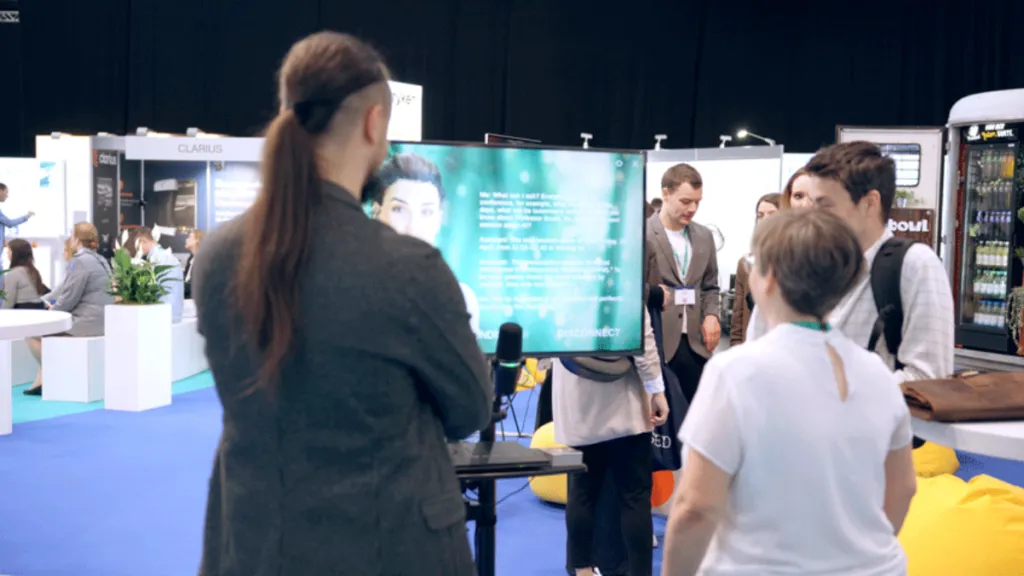
We deployed an assistant that attendees could walk up to and simply ask, out loud, the way they would ask a colleague. No app to download, no interface to learn, nothing to type on a phone.
Session recommendations, not a search box
With hundreds of sessions running at once, the most valuable thing was pointing someone at the right one. The system knows the whole congress schedule and answers questions like “what is happening right now on colorectal surgery”, which a desk staffer would answer by flipping through a binder.
The whole event, not just the programme
The assistant also answers questions about exhibitors, the organising institution and how to get across the venue. A retrieval system connected to the complete event database keeps those answers current instead of frozen at the moment something was printed.
Voice that works on a congress floor
A congress floor is acoustically hostile: hundreds of simultaneous conversations, PA announcements, foot traffic. We combined professional microphone hardware with software noise reduction so speech recognition holds up in the loudest areas, and parallelised the processing so responses come back fast enough to feel like a conversation.
A kiosk and a headset
The assistant ran on a large screen kiosk for quick walk-up questions and as an immersive VR experience on Meta Quest 3, which leaves the visitor the choice between fast utility and something worth stopping for.
What changed
The results
Before
Printed programmes, static signage and staffed information desks. Limited capacity at peak hours, no personal session recommendations, and schedule changes that travelled slowly.
After
An assistant handling visitor questions on demand, personal session recommendations from the full schedule, and continuous availability across four congress days with no queuing.
The assistant ran across all four congress days, giving visitors immediate answers about which session to attend, where to find an exhibitor and how to get through the venue.
That is guidance which otherwise requires someone to work through a printed programme by hand, at exactly the moment when nobody has time to.
For organisers and exhibitors it is a repeatable model rather than a one-off installation: the same system can be reconfigured for any event with structured schedule data, from trade fairs to corporate conferences.
Questions about this project
Automated session guidance and visitor support. A four-day congress with hundreds of parallel sessions and thousands of attendees, and no scalable way to give personal session guidance and event information without dedicated staff at every turn.
Continuous visitor support across the full congress: 4 days. Parallel sessions navigated, with personal recommendations: 100s. Natural speech, no typing and no app download: Voice.
LLM with RAG and speech processing. Technology used: Large Language Models, RAG architecture, Speech-to-text, Text-to-speech, Function calling, WebSockets, Meta Quest 3 and VR, Noise reduction, AI avatar.
Technology used
Talk to the people who built this
theBlue.ai comes back within one business day.
More case studies
HealthTech · Xpomet Medicinale 2024
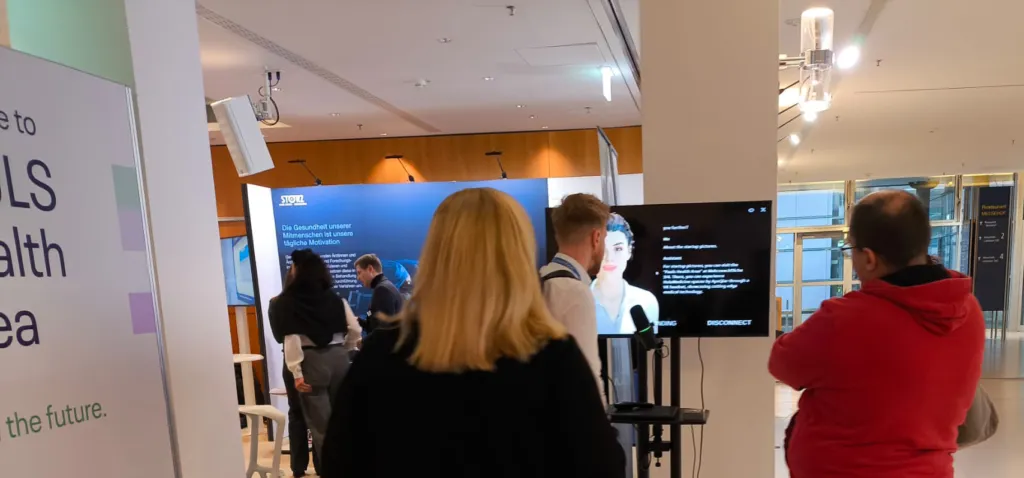
An AI avatar handling repeat visitor questions at a congress
Read more
Government · Polish institution, under NDA
A multi-agent chatbot across eleven knowledge areas
Read more
MedTech · apoQlar