
HealthTech · Events and conversational AI
An avatar that answers the visitor questions a help desk cannot keep up with
At XPOMET Medicinale 2024 in Leipzig we deployed Paula, a voice-activated AI avatar that handled visitor questions, navigation and exhibitor recommendations in real time. Built together with Johannesstift Diakonie, Paula took over what would otherwise need dedicated information staff, in a noisy, high-traffic conference environment.

Key results
Client: Johannesstift Diakonie
Johannesstift Diakonie Services GmbH, at XPOMET Medicinale 2024 in Leipzig, one of Europe’s leading healthcare innovation conferences.

- Industry
- HealthTech and events
- Use case
- AI avatar for visitor guidance
- AI approach
- LLM with speech and function calling
- Languages
- English and German, detected automatically
- Environment
- Live conference, high noise
- Partner
- Johannesstift Diakonie
In short
What an information desk cannot do at peak hour
- XPOMET Medicinale brings dozens of exhibitors, a packed presentation schedule and an international audience into one crowded, noisy hall.
- Finding a booth, checking a session time or asking about a company traditionally means a staffed help desk, which is expensive, uneven, and does not scale when everyone arrives at once.
- Paula takes the question out loud, in English or German, and answers from the full event database with exhibitor details, programme and booth locations.
- She activates on “Hallo Paula” with wake-word detection running on the device, shows the relevant exhibitor logos on screen, and can search the live web for anything outside the programme.
The starting point
The challenge
Build an interactive assistant that handles visitor questions in real time, in more than one language, in a live conference setting, and replaces the need for manual information desk staffing.
XPOMET Medicinale is a large healthcare innovation conference with dozens of exhibitors, a packed presentation schedule and a diverse international audience. Attendees have to find specific booths, check schedules and get information about companies and sessions, all while moving through a noisy, crowded space.
Traditionally that requires dedicated staff at help desks, people who know the full event schedule, the exhibitor details and the venue layout. Staffing it is expensive, inconsistent, and it does not scale to peak traffic when everyone arrives at once or a session changes.
The brief was to replace that with something a visitor can simply talk to.
The build
What we built
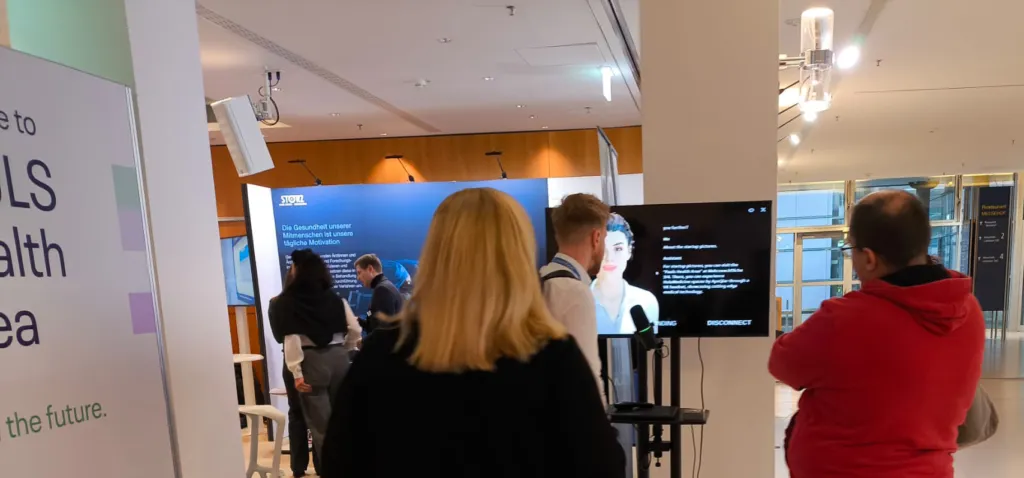
We built and deployed Paula, a voice-activated AI avatar stationed in the Pauls Health Area. Not a chatbot on a screen: a conversational system that holds a spoken dialogue with a visitor.
She works out which language you are speaking
Paula detects whether a visitor is speaking English or German and answers in that language, with no manual selection. A visitor can switch languages in the middle of a conversation and she follows.
Wake word processed on the device
A conversation starts with “Hallo Paula”. The wake-word model runs locally on the device, so no audio goes to the cloud just to activate her. She also notices when a conversation has ended and deactivates by herself.
The event database, reachable by question
Paula has access to the full event database: exhibitor details, the conference programme, session times and booth locations. Through LLM function calling she answers specific questions like “which companies are presenting on digital pathology” and recommends sessions based on what a visitor says they are interested in.
The screen follows the conversation
While she talks, Paula reads the visitor’s intent and puts the relevant exhibitor logos and details on screen. That turns a voice exchange into visual navigation, which is what someone standing in a hall actually needs.
Live web search for everything else
Beyond the event, Paula answers general questions using live web search, from the local weather to a factual question, which makes her useful outside conference logistics too.
What changed
The results
Before
Visitor guidance handled by information desk staff. Limited capacity at peak hours, one language at a time, and no personal recommendations.
After
An avatar handling visitor questions in two languages with no queue, personal exhibitor recommendations, visual navigation, and no dependency on staffing levels.
Paula handled visitor interactions throughout the event and gave consistent, accurate information regardless of how busy the floor was. Nobody waited in line or searched a printed programme.
The multilingual capability was particularly well received by the international audience, which is the part a single-language help desk cannot cover.
For exhibitors she worked as an additional discovery channel, sending visitors to relevant booths and sessions based on what they had said they were looking for.
The deployment also showed that a conversational avatar holds up in real conditions rather than a quiet demo room: noise, crowds and unpredictable behaviour.
Questions about this project
AI avatar for visitor guidance. Build an interactive assistant that handles visitor questions in real time, in more than one language, in a live conference setting, and replaces the need for manual information desk staffing.
English and German detected automatically, switchable mid-conversation: 2 langs. Real-time voice interaction in a noisy conference hall: Live. Wake-word detection on the device, nothing sent to the cloud: Local. Live web search alongside the event database: Web + DB.
LLM with speech and function calling. Technology used: Large Language Models, Speech-to-text, Text-to-speech, Function calling, Local wake-word detection, Automatic language detection, Real-time web search, AI avatar.
Technology used
Talk to the people who built this
theBlue.ai comes back within one business day.
More case studies
Healthcare · German Congress of Surgery
A voice assistant answering attendee questions for four days
Read more
Government · Polish institution, under NDA
A multi-agent chatbot across eleven knowledge areas
Read more
MedTech · apoQlar