
LLMs & AI Agents · Documents and knowledge
LLMs & AI Agents in Business Applications: Document and Data Solutions
Hours spent digging through contracts, policies or manuals, asking two colleagues, searching SharePoint and scrolling through a 60-page PDF: many people know the feeling. With LLMs, tools and agents, those documents become a knowledge source that answers questions in seconds, with a source.
 Julia Rose
Key takeaways
- Keyword searches return long result lists but no clear answer, and old versions sit next to new ones.
- LLMs understand language but only know their training, do not access company data and do not act on their own.
- With tools for data access and specialised agents, they become business tools that deliver sourced answers.
- Quality depends on the documents: structure, freshness, completeness and governance.
Why traditional search is no longer enough
Most companies have search functions in their document management systems. But keyword searches and static indexes quickly reach their limits:
- You get long lists of results but no clear answer.
- Data is scattered, compliance rules in one folder, contracts in another.
- Policies change, but old versions stay on shared drives.
The result: employees lose time, answers are inconsistent, and compliance risks creep in. What is needed are systems that understand language and context.
What LLMs can do and where they fall short
Large language models (LLMs) are AI systems trained on vast amounts of text. They understand and generate language. Instead of forwarding a 40-page guideline, an LLM summarises the three rules that matter in seconds, like a colleague who always has time to explain complex material simply.
On their own, though, LLMs have three limits:
- They only know what they learned in training.
- They do not automatically access company documents or data.
- They do not take actions, they produce text.
LLMs with tools and agents
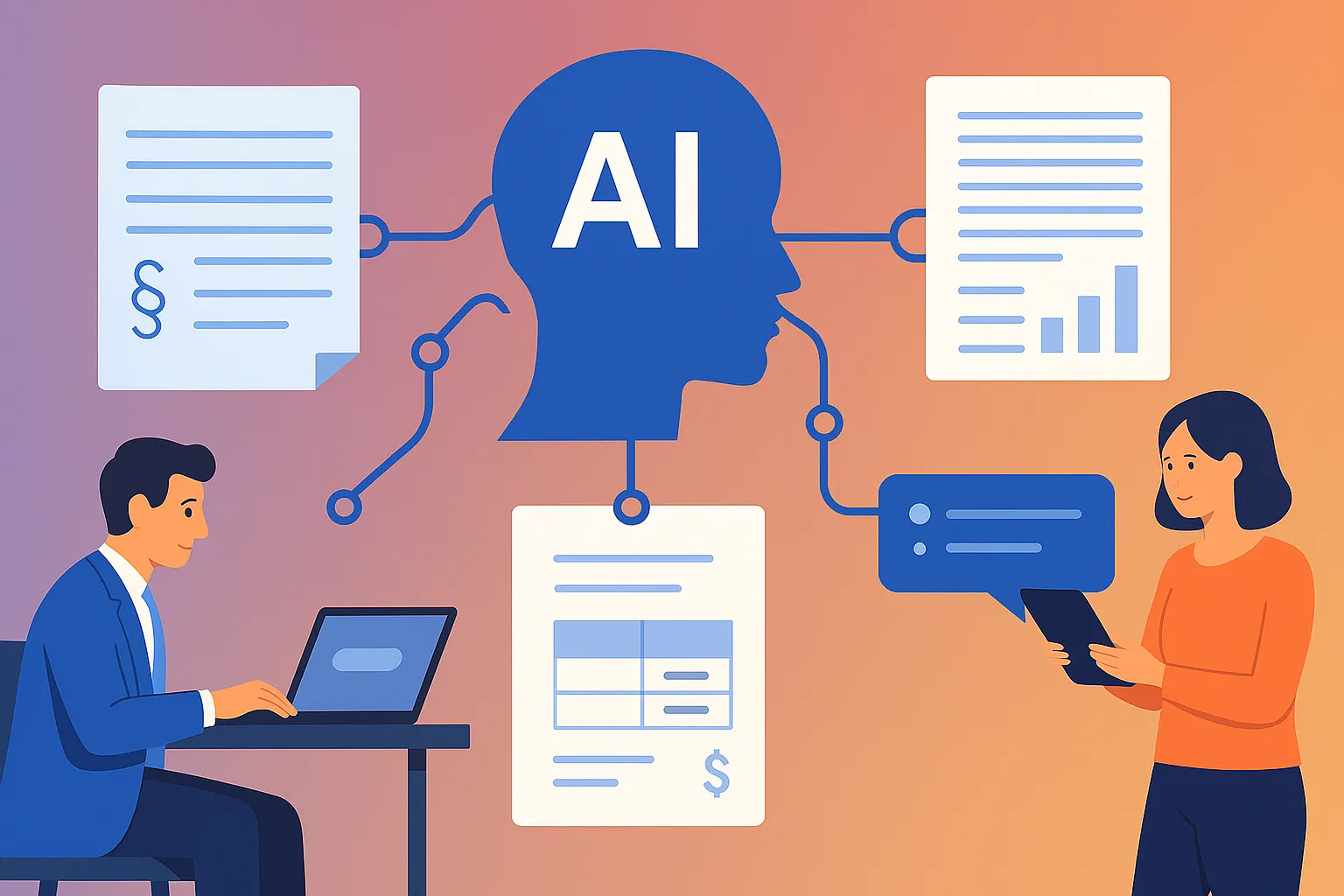
Connected to company systems and embedded in a multi-agent platform, LLMs become real business tools:
- Tools give access to the right data: contracts, emails, CRM systems, document archives.
- Agents take on specialised tasks, for example one for compliance, one for HR, one for technical documentation.
- The platform coordinates who does what and routes every request correctly.
Think of it as an AI team: the LLM is the brain, the tools are the hands, the agents are the specialists. Together they turn static documents into usable knowledge. Our article Five agents, one orchestrator shows how such multi-agent systems are built.

Practical example: speeding up internal information search
A maintenance technician asks: “What is the correct torque setting for installing part X on model Z?” Depending on the setup, the answer differs widely:
| Setup | Result |
|---|---|
| LLM alone | Might guess or return irrelevant information. |
| LLM with tools | Searches the service manuals. |
| LLM with tools and agents | The maintenance agent extracts the exact value from the current manual, cross-checks it against the latest service bulletin and returns the torque setting with a source. |
The result: faster maintenance, fewer errors, better safety.
More use cases
Wherever knowledge is buried in documents, such systems make it reliably accessible. Examples from our projects:
MedTech: product documentation and security questionnaires
For apoQlar, an assistant answers questions from hundreds of product documents in seconds, each answer with a source. A second one pre-fills extensive security questionnaires from approved policies and technical documentation, cutting processing time by 75%.
Read the document search case study · Read the security questionnaire case study
Consulting: research across internal knowledge and web sources
For a consultancy, an AI toolbox first searches a private database of more than 8 million documents and extends the search to selected web sources where needed. The result is structured reports to the client’s specifications.
What companies need to make it work
Even the best AI is only as good as the information it works with. Unstructured, outdated or contradictory documents lead to unreliable answers. What matters:
- Structure: documents should be readable for people and machines, meaning searchable formats instead of scans, one official version instead of many drafts, clear headings and sections.
- Freshness: if last year’s policy sits next to the current one, the AI may quote the wrong version. Only valid documents belong in the knowledge base.
- Completeness: missing documents mean missing answers.
- Governance: processes to monitor accuracy, collect feedback and update documents when things change.
Feeding an LLM unstructured or outdated content is like handing a lawyer half-written contracts. Clean, current and well-organised information is the foundation of every successful AI project. Our article on reliable RAG systems covers what matters when building one.
How to start without turning the company upside down
The best results come from starting small and then scaling quickly:
- Identify the need: where is the most time lost searching for knowledge, for example in compliance, HR or documentation?
- Prepare the data: structure and clean documents before connecting AI.
- Run a pilot: pick one clear use case and prove the value.
- Expand step by step: add more processes and agents.
- Monitor quality: collect feedback and keep improving.
That keeps risk low, and early wins build acceptance internally. In the end, a question in plain language gets a precise, sourced answer. Our RAG development page shows how we build such systems.

Making knowledge in your documents usable?
In the process analysis we look at where your team loses the most time searching, which documents and systems to connect and what a pilot looks like.
Request a process analysisFrequently asked questions
Keyword searches return result lists instead of answers, struggle with scattered information and do not reliably distinguish current from outdated versions.
Tools give the model access to company data, and agents take on specialised tasks and check results. That produces sourced answers instead of guesses.
Contracts, policies, manuals, product documentation and similar texts, provided they are searchable, current and complete.
With a clearly scoped pilot in the area where searching for knowledge costs the most time. Documents are structured and cleaned beforehand.
Julia has been part of theBlue.ai since 2019 and has accompanied the development of AI applications in the enterprise environment since the company’s early days. In her role as Marketing Lead, she works closely with the engineering and consulting teams and makes complex technical topics understandable and accessible for decision-makers.
In her articles, she writes about practical experience from enterprise AI projects, as well as the challenges and opportunities of using AI in companies.