
Process Automation · Decision models
Decision models: fast, low-cost AI for everyday business decisions
Most companies make thousands of small decisions a day: which team gets a ticket, whether an email is a complaint or an order, whether a message is urgent. Since September 2026 a new class of AI has been built for exactly this work. It answers in well under a second for a fraction of a cent, and it is ready for production use today.
 Aleksandra Osztynowicz
Key takeaways
- A decision model picks one answer from a fixed list and returns a probability. It writes no text, which is why it is fast.
- With the providers we have tested, only the input text is billed. The same job runs 10 to 100 times cheaper than on an LLM.
- Confidence scores rank cases well but certify none. The threshold for automatic decisions belongs on your own data, set separately per language.
- An audit across 51 languages found a threshold calibrated on English still held in 8 of them (Brom, 2026).
- In most processes the two work together. The decision model settles the clear cases and the rest goes to an LLM.
What small decisions cost
Assigning incoming work takes up a large part of many teams’ day. A service desk puts tickets into queues. A logistics team reads shipping emails and decides who handles each one. A back office sorts documents by type before anyone touches them. None of these steps needs a thought. Every one of them needs someone to read.
Companies have automated this in two ways so far, and neither fits well. Fixed rules break as soon as people phrase things differently. General-purpose large language models handle any phrasing, but each call takes seconds and costs more than the decision is worth once it runs 50,000 times a month.
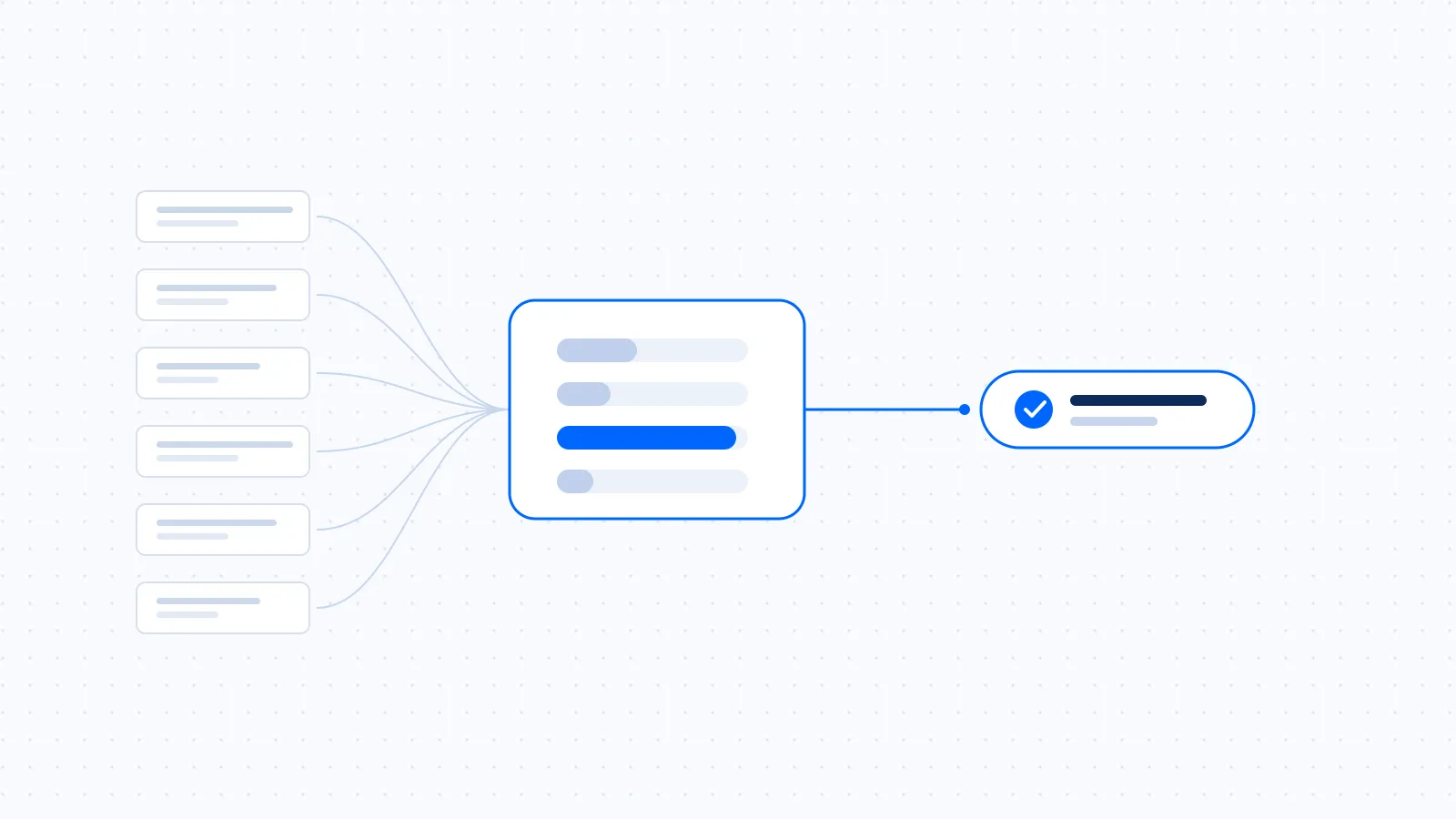
Decision models are built for that gap. The model receives the text, and some models also take images, together with a fixed list of possible answers. It returns one of those answers with a probability, in a single pass, without writing anything.
Most decision models start from the same kind of language model as ChatGPT or Copilot, retrained to score options instead of writing text. The difference shows in how the answer is produced. An LLM writes its reply word by word, so even a one-word label arrives as text that the receiving system has to read and check, and every word adds time and cost. A decision model writes nothing. It reads the input once and scores each of the predefined options, so the answer is always one of them. With the providers we have tested, only the input text is billed. That is why the same job typically runs 10 to 100 times cheaper than on an LLM, depending on which models you compare.
The price of that speed is a narrower job. A decision model gives no explanation, writes no summary, does no arithmetic and never answers outside the defined options. For a step that only has to pick the right queue, label or next action, that is exactly what is needed, at a cost low enough to run on every ticket, email and document in a process.
A market that formed in six weeks
TypeSafe launched one of the first decision models, Jev, in September 2026. Within weeks OpenAI, Microsoft, AWS and Cloudflare had released their own, some as hosted services and some as open models that run on a company’s own servers.
They are no longer experiments. Companies already use them in production, and some are replacing the models they used before wherever a choice from a closed list is enough.
New ones arrive every few days, and they increasingly differ by purpose. Some are tuned for security checks, some are small enough to run on a single company server, some cover many languages, some read images as well as text. That makes it possible to choose a model for the specific problem rather than one model for everything.
Where they fall short
Vendor benchmarks show decision models at their best. In our own projects we see three limits that matter once a model runs in a real process. Independent research points the same way.
Language
Most decision models are trained and calibrated mainly on English. In our experience the same model is slightly less accurate on the same task in Polish than in English, and its confidence scores become less trustworthy. An audit across 51 languages reached the same conclusion: a confidence threshold calibrated on English still kept its promise in only 8 of them (Brom, 2026).
For a company working in German or Polish, language is therefore the first thing to test. Both sides of it: the language of the input text and the descriptions of the options the model chooses from, because either one can move the result (Galtea, 2026).
Confidence
Every answer comes with a probability that shows how sure the model is. If it gives 0.9 for “complaint”, roughly nine out of ten answers like that should be right. That makes the number good for sorting: the higher it is, the more likely the answer is correct.
What the number cannot do is promise that a particular answer is right. The scores rank cases well but certify none of them, so some wrong answers still arrive with high confidence (Xiong et al.). We have seen this in our own tests. The scores are also only as reliable as the task they were checked on. On categories specific to a single company, a 0.9 may mean the model is right far less often than nine times in ten.
That is why the model is first tested on the company’s real data, and the threshold above which decisions run automatically is set from those results, separately for each language.
Domain knowledge and calculations
On well-defined, general questions decision models keep up with LLMs. Their advantage is cost and speed, not accuracy, and they fall behind on multi-step maths: on MathQA one of them scored 17.7 points below the median of the frontier models and below all 19 LLMs it was compared with (Li et al., 2026).
In our experience the gap shows wherever the right answer depends on specialist knowledge, for example knowing which team owns a problem when that depends on how a particular business system works.
Decision models also do not calculate. Comparing the amount on an invoice with the purchase order, or checking whether a payment deadline has passed, is better done by a rule or a few lines of code. The decision model handles the part that needs the text understood, for example recognising whether a document is an invoice or a credit note.
Decision models and standard LLMs
Both can automate work inside the same process, but they work differently, and each is the right tool for a different kind of task.
| Decision model | LLM | |
|---|---|---|
| What it returns | One answer from a closed list, with a probability | Open text: answers, explanations, summaries, drafts |
| Fits best | High volume, clear options, English or a tested language | Decisions that need domain knowledge or reasoning, at moderate volume |
| Running cost | Fractions of a cent per decision | Typically 10 to 100 times more |
| Watch for | Language, confident wrong answers | Cost at scale, self-reported confidence is unreliable |
In most processes we see, the best setup combines the two, for two separate reasons. First, a decision model cannot do what an LLM does. It only picks from a fixed list, so any step that needs text written stays with the LLM: a reply, a summary, extracted details. Second, even where a choice from a list is enough, the decision model settles only the cases it is confident about and passes the rest on.
Take a customer service inbox. A decision model reads every incoming email and decides within a second whether it is an order, a complaint or a question, and how urgent it is. Orders and routine questions go straight to the right queue. Only complaints, and emails the decision model is unsure about, are passed to an LLM, which drafts a reply or extracts the details the next step needs. The inbox is sorted almost instantly, and the slower, more expensive model runs on a fraction of the emails instead of all of them. We described the process side of this in Automating the email inbox.
How we build a production setup
Choosing the model is the first step and the smallest one. What makes a decision model safe to run in a live process is the setup around it. The points below match what the first independent evaluation checklists for this model class ask for (Tang and Zheng, 2026).
- The model is never hard-wired. It sits behind the company’s own interface, so moving to a better or cheaper model is a configuration change rather than a rebuild. Every change is tested before it goes live, including a vendor’s own update.
- Every decision is logged, including the model version. That supports audits and the record keeping the EU AI Act requires for high-risk uses.
- Option descriptions are tested like code. They carry the company’s business rules.
- Data stays where it has to, in an EU region or on the company’s own servers.
- Input text is treated with caution. A few natural sounding sentences added to an email can be enough to push a model to the wrong answer, so this is tested before go-live (Xu et al., 2026).
- Uncertain cases are passed on to an LLM or a fallback rule instead of being decided automatically.
The right model for each decision
Decision models make it affordable to automate the small, repetitive decisions an LLM is too slow and too expensive for. They always choose from a closed list, and they give their best results in a tested language with a threshold set on the company’s own data. Where a step needs text written or specialist knowledge, the LLM stays in the process, and in most cases the two work together.
At theBlue.ai we test decision models and LLMs side by side and build both into business processes, for clients and inside our own company. From that work we know where each one pays off and where it does not. How we scope projects is on the page How we work.
theBlue.ai is an enterprise AI company with offices in Hamburg and Poznań. The team has worked on AI projects since 2016 and belongs to the Apollogic group with more than 120 developers. More about us on the page About us.
Sources: Brom (2026), “Confidence Is Not a Promise: A Reference Audit of Typed Decision Models” for the confidence threshold across 51 languages. Li et al. (2026), “Specialized Decision Models vs. General-Purpose LLMs” for the gap on multi-step maths. Tang and Zheng (2026), “Typed Decision Models: An Early Evidence Audit and Evaluation Checklist” for the checklist. Xu et al. (2026), “JevOut: Natural Context Can Flip Decision Models” for manipulated input. Xiong et al., “Can LLMs Express Their Uncertainty?” for self-reported confidence. Galtea (2026) for the effect of language. OpenAI, Decisions for how the interface is built.

Planning an AI project?
In the process analysis we map your workflows, rank the possible use cases by return and propose an architecture.
Request a process analysisFrequently asked questions
An AI model that picks exactly one answer from a fixed list of possible answers and returns a probability with it. It writes no text and never answers outside the list. It is built for steps such as: which team gets this ticket, is this email a complaint, what type of document is this.
On the same job, typically 10 to 100 times, depending on which models you compare. The reason is that with the providers we have tested only the input text is billed. A single decision costs fractions of a cent, which keeps it affordable at 50,000 cases a month.
For sorting yes, as proof no. A high score means the answer is more likely to be correct, but it certifies no single case, and some wrong answers do arrive with high confidence. The threshold above which decisions run automatically therefore belongs on your own data, set separately for each language.
They work, but not untested. The models are calibrated mainly on English. An audit across 51 languages found that a confidence threshold set on English held in only 8 of them (Brom, 2026). Both sides need testing: the language of the incoming text and the language of the option descriptions.
Whenever the step has to produce text, such as a reply, a summary or extracted details, whenever the right answer depends on specialist knowledge about a particular system, or whenever something has to be calculated. In most processes the two run side by side: the decision model settles the clear cases and the LLM gets the rest.
Aleksandra has been building custom AI solutions at theBlue.ai since 2021, with a focus on agentic implementations and local LLM deployments that precisely fit enterprise needs. As an AI Engineer, she helps organizations automate their processes with production-grade systems, from on-premise open-source models to RAG-based internal knowledge bases for regulated industries, and continuously expands her knowledge in the rapidly changing world of artificial intelligence.
In her articles, she shares practical experience from real enterprise AI projects and shows that deploying AI in companies doesn’t need to be complicated.