Enterprise AI & Strategy · MVP-first
Building AI That Works: Our MVP-First Approach to Enterprise AI Workflows
Whether in manufacturing, healthcare, retail or finance, companies want measurable results from AI. Yet the path from idea to production often feels uncertain. Our answer: start lean, iterate fast, validate early.
 Julia Rose
Key takeaways
- In AI, data quality, model performance and adoption can only be judged once something concrete is built and tested.
- An MVP solves one central problem first and is designed to move into production later.
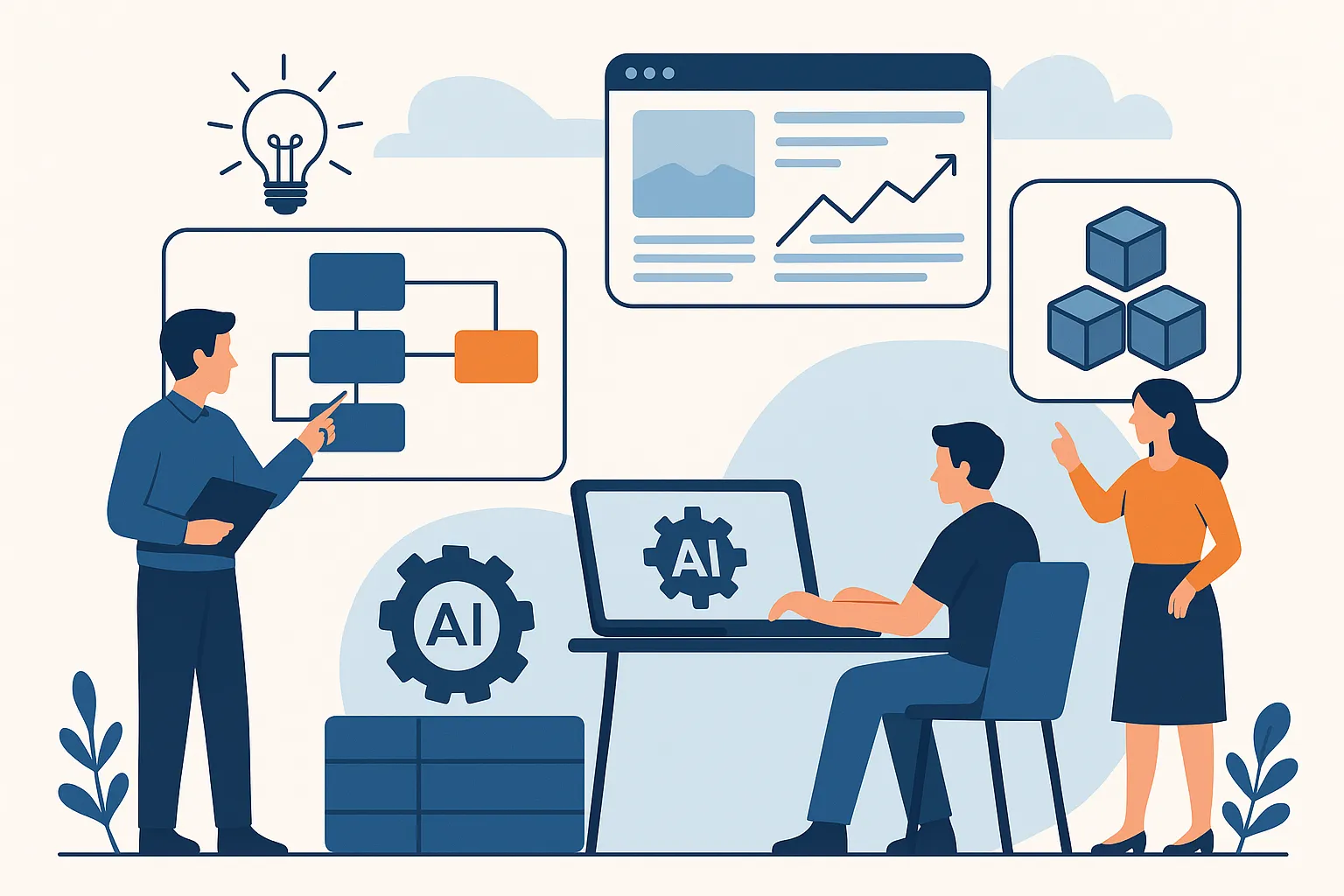
- Six steps lead there: an idea with business value, data review, prototype, validation, iteration, operation with monitoring.
- The benefit: less risk, visible results fast and only proven solutions scaled up.
Why MVP-first matters in AI
Traditional IT projects often follow the waterfall model: gather requirements, design in detail, build for months, then test. In AI this rarely works, because AI thrives on experimentation. Data quality, model performance and user adoption can only be judged once something concrete is built and tested in practice. Our approach therefore rests on four principles:
- Speed: a working prototype within a few weeks.
- Validation: testing assumptions with real data and workflows.
- Focus: solving one critical problem first, then expanding.
- Scalability: building so the solution can move into production later.
| Step | Outcome |
|---|---|
| 1. Idea with business value | One or two prioritised use cases with clear KPIs |
| 2. Data review | Gap analysis: what is usable now and what needs preparation |
| 3. Prototype | A usable MVP for the core workflow, usually in four to six weeks |
| 4. Validation | Metrics and feedback from real users, decision on scaling |
| 5. Iteration | Higher accuracy, better usability, integration with enterprise systems |
| 6. Operation | Production system with monitoring, updates and audit functions |
1.Ideation with business impact
It starts with business goals. We ask:
- Which decision or process should improve?
- Where does inefficiency cost the most?
- How can success be measured in numbers, such as savings, revenue, time or quality?
In workshops with business and technical teams, we work out realistic, business-relevant use cases. In manufacturing this could be predicting machine downtime, in healthcare partly automating medical documentation. The result is one or two prioritised use cases with clearly defined KPIs.
2.Data discovery and readiness check
AI is only as strong as its data. Before development we therefore assess data readiness:
- What data exists, and where is it stored?
- Is it accessible, clean and labelled?
- Which regulations apply, such as GDPR or HIPAA?
Large enterprises in particular often underestimate the effort of data preparation. A gap analysis shows which data is usable immediately and which needs preparation or integration. This creates clarity early, avoids wasted effort and sets realistic expectations for the MVP.
3.MVP design and rapid prototyping
With clear goals and reviewed data, the MVP is built. Three principles guide us:
- Focus on the core workflow: the MVP solves one problem end to end, not all of them at once.
- Proven components: pre-trained models, open-source libraries and our own tools shorten development.
- User-centred design: simple interfaces such as dashboards or API integrations, so stakeholders can test the workflow in their own environment.
For example, instead of building a company-wide knowledge assistant right away, we start with one department, say HR, and deploy an LLM there that answers policy and compliance questions and relieves the helpdesk of routine requests. This step usually takes four to six weeks and delivers something tangible.
4.Validation with real users
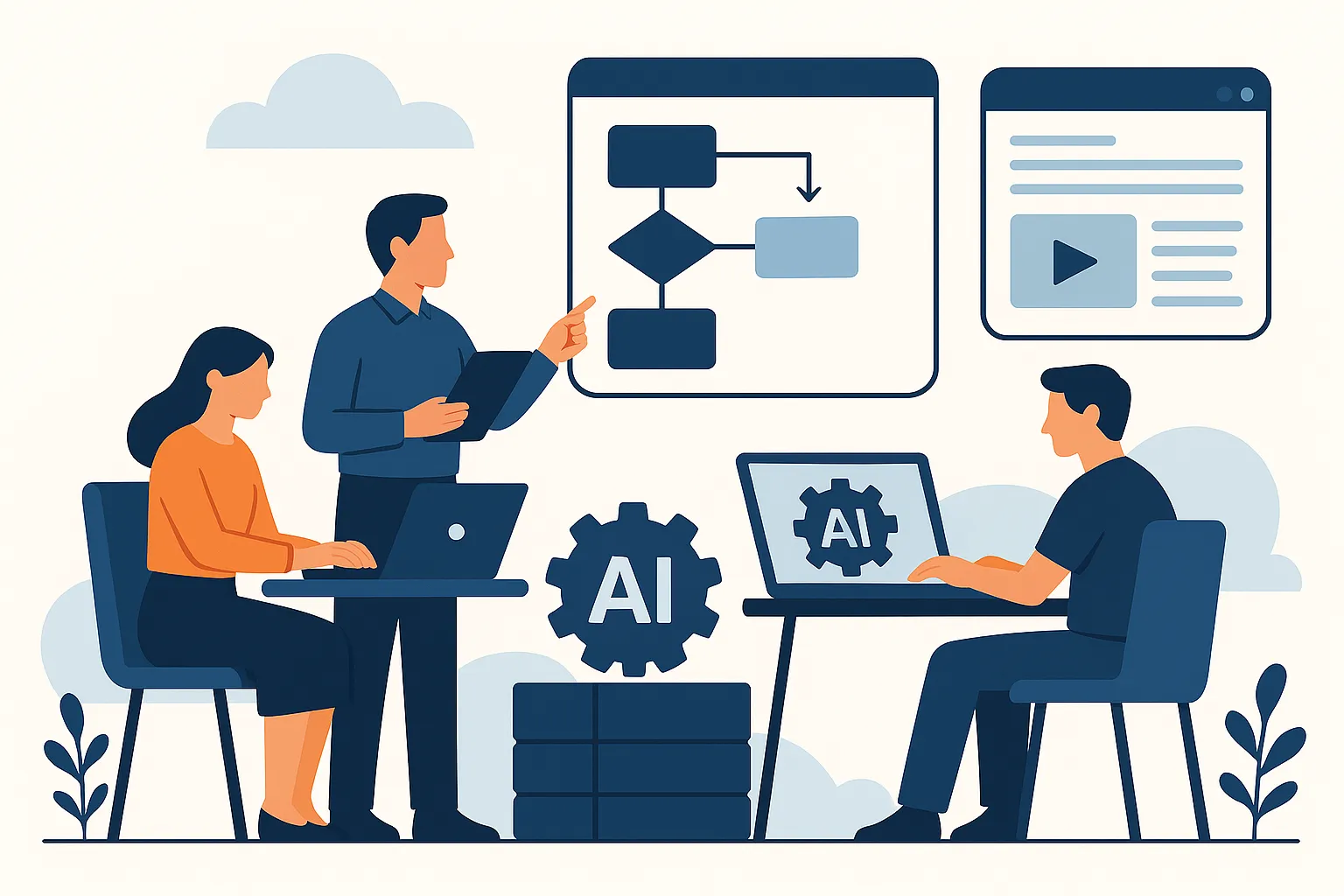
An MVP is valuable when it proves itself in practice. We first test it in a controlled setting with selected users and measure:
- Performance: accuracy, speed, error rates.
- Feedback: usability, trust, fit with existing workflows.
- Robustness: stress tests with real edge cases.
This phase often reveals assumptions nobody had considered, for instance that users interpret model outputs differently or that data pipelines need adjusting. The goal here is evidence: does the MVP deliver real value, and is the next step worth it?
5.Iteration and scaling
After validation comes iteration. Depending on results, that means improving model accuracy with more data, refining usability for better adoption, integrating with enterprise systems such as ERP, CRM or cloud platforms, and hardening infrastructure for reliability and compliance. We work on a “deploy, learn, improve” cycle, and each round brings the solution closer to production. Scaling also includes governance, monitoring and training so the solution lasts.
In practice: Radaway
At Radaway we took an existing LLM system for email orders into production in three weeks. Manual intervention in order entry fell by around 90%.
6.Deployment and continuous monitoring
Once the workflow is production-ready, rollout follows enterprise standards:
- Cloud or on-premises deployment, depending on security needs.
- CI/CD pipelines for fast updates.
- Monitoring dashboards for performance and usage.
- Built-in compliance and audit mechanisms.
An AI project is not finished at rollout. Models need monitoring and adjustment as data changes. That is why we set up monitoring and retraining processes with our clients so the solution stays reliable.
The advantage for enterprises
- Less risk: instead of a large upfront investment, an MVP provides early evidence of value.
- Faster results: results arrive within weeks, which builds momentum with decision-makers.
- Sustainable scaling: only what has proven itself in validation gets scaled.
The best AI is the one that delivers real business value and can grow sustainably. With MVP-first, companies can experiment confidently, learn fast and invest deliberately. Our How we work page describes how we shape this path.

Planning an AI project?
In the process analysis we map your workflows, rank the possible use cases by return and propose an architecture. Fixed price from €3k.
Request a process analysisFrequently asked questions
Building a minimum viable product first that solves one central problem end to end, testing it with real data and users, and only then scaling it.
Usually four to six weeks, after ideation and the data review.
Because data quality, model performance and adoption can only be judged reliably on a working prototype. Long planning phases without testing therefore carry high risk.
The solution is improved iteratively, integrated with enterprise systems and moved into operation with monitoring, updates and audit functions.
Julia has been part of theBlue.ai since 2019 and has accompanied the development of AI applications in the enterprise environment since the company’s early days. In her role as Marketing Lead, she works closely with the engineering and consulting teams and makes complex technical topics understandable and accessible for decision-makers.
In her articles, she writes about practical experience from enterprise AI projects, as well as the challenges and opportunities of using AI in companies.