
LLMs & AI Agents · Summarisation
Generative AI for Summaries: Getting to the Point of Documents Faster
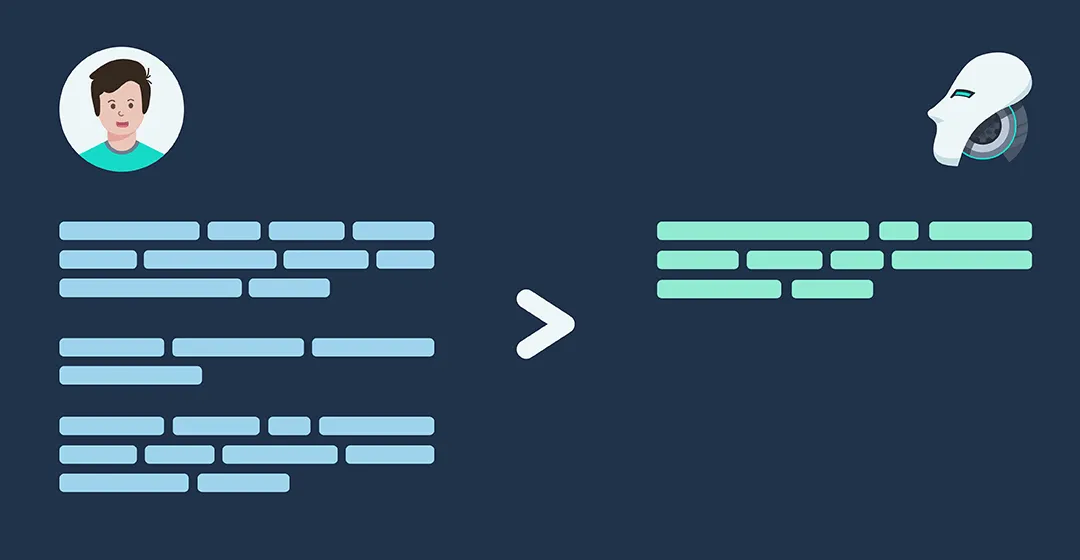
Reports, policy documents, contracts, call notes: many teams spend a large part of their day reading and summarising. Generative AI takes over this step as soon as a document arrives. Two projects from policy monitoring and customer service show what matters.
 Julia Rose
Key takeaways
- Language models summarise long documents in seconds, in several languages and in the required format.
- Good summaries come from context: document type, source, topic and the question the reader has.
- At Policy-Insider.AI, policy documents are summarised as they are published and sent out by email to the right people.
- At arvato, an MVP shows that a system can write the note after every call.
Where automatic summaries pay off
Wherever people have to read a lot to find a little that matters, summarising costs time and ties up experts. Typical examples:
- Policy and market monitoring: new draft laws, statements, studies and industry news.
- Customer service: notes after calls, chats or email threads.
- Legal and procurement: key points from contracts, tenders and supplier documents.
- Management and projects: reports, minutes and long email threads at a glance.
- Knowledge management: short versions for document repositories so content is easier to find.
What makes a good summary
A language model can shorten any text. A summary only becomes useful when it answers the reader’s questions. For that, the system needs context:
| Lever | Effect |
|---|---|
| Document type and source | A draft law is summarised differently from a press release. |
| Reader’s interests | The summary focuses on the topics that matter to this person. |
| Fixed format | Consistent fields such as issue, outcome and next steps make summaries comparable. |
| Long documents | Relevant sections are selected first so nothing important gets lost. |
| Language | Documents in one language, summary in the reader’s language. |
Two projects in practice
In practice: Policy-Insider.AI
Public affairs teams track hundreds of policy documents from EU institutions every day, often in different languages. For the Policy-Insider.AI platform we built an AI layer that summarises each document as it is published. The prompts carry document type, institution and policy area as context. Users set up an interest profile and receive by email only the summaries on their topics. Analysts read less and interpret more.
In practice: arvato
In arvato’s call centre, agents wrote a note by hand after every customer call, with varying quality. In an MVP, a speech recognition and summarisation pipeline produces a note in a fixed format for every call: intent, category, actions taken, next steps. Custom models were trained for Polish.
How quality is kept up in production
The quality of generated text is hard to check at scale. Three risks stand out: inconsistent output, invented statements and summaries that leave out what matters most. What works:
- A test set of real documents: experts define what a good summary has to contain.
- Automatic evaluation: every change to the prompt or model is checked against this test set.
- Traceability to the source: statements can be traced back to the passage in the original document.
- Feedback in operation: users flag weak summaries, and their input feeds into improvements.
For Policy-Insider.AI we built an iterative evaluation pipeline for this. More in our article LLM observability and monitoring.
How to get started
- Pick a document type: one kind of document or conversation that costs a lot of reading time today.
- Define the format: what should every summary contain, and for whom?
- Test with real examples: experts compare the results with their own summaries.
- Build it into the workflow: the summary appears where people work, such as the CRM, the document view or an email.

Read less, decide faster?
We look at which documents or conversations suit automatic summaries and how they reach your systems.
Request a process analysisFrequently asked questions
A language model receives the document or its relevant sections together with context such as document type, topic and the required format, and writes a summary from it.
That depends on context, prompt and ongoing checks. With test sets, automatic evaluation, traceability to the source and user feedback, quality stays stable in production.
Yes. Conversations are first converted to text with speech recognition and then summarised, for example as a CRM note after a customer call.
Yes. The summary can be written in the reader’s language even when the document is in another language.
Julia has been part of theBlue.ai since 2019 and has accompanied the development of AI applications in the enterprise environment since the company’s early days. In her role as Marketing Lead, she works closely with the engineering and consulting teams and makes complex technical topics understandable and accessible for decision-makers.
In her articles, she writes about practical experience from enterprise AI projects, as well as the challenges and opportunities of using AI in companies.