
AI Avatars & Spatial Computing · Use cases
AI Avatars: Business Applications in Banking, HR, Sports and Sales
AI avatars give chatbots and virtual assistants a face, a voice and a personality of their own. Companies use them in bank customer service, in onboarding new employees, in athlete training and in sales, wherever a conversation should feel personal.
 Julia Rose
Key takeaways
- AI avatars combine chatbot functions with artificial intelligence and a human appearance.
- Emergen Research expects the digital human avatar market to reach USD 561.16 billion by 2032.
- Applications include banking and finance, human resources, sports and sales.
- Avatars take work off teams and simplify processes. They are not meant to replace employees.
What are AI avatars?
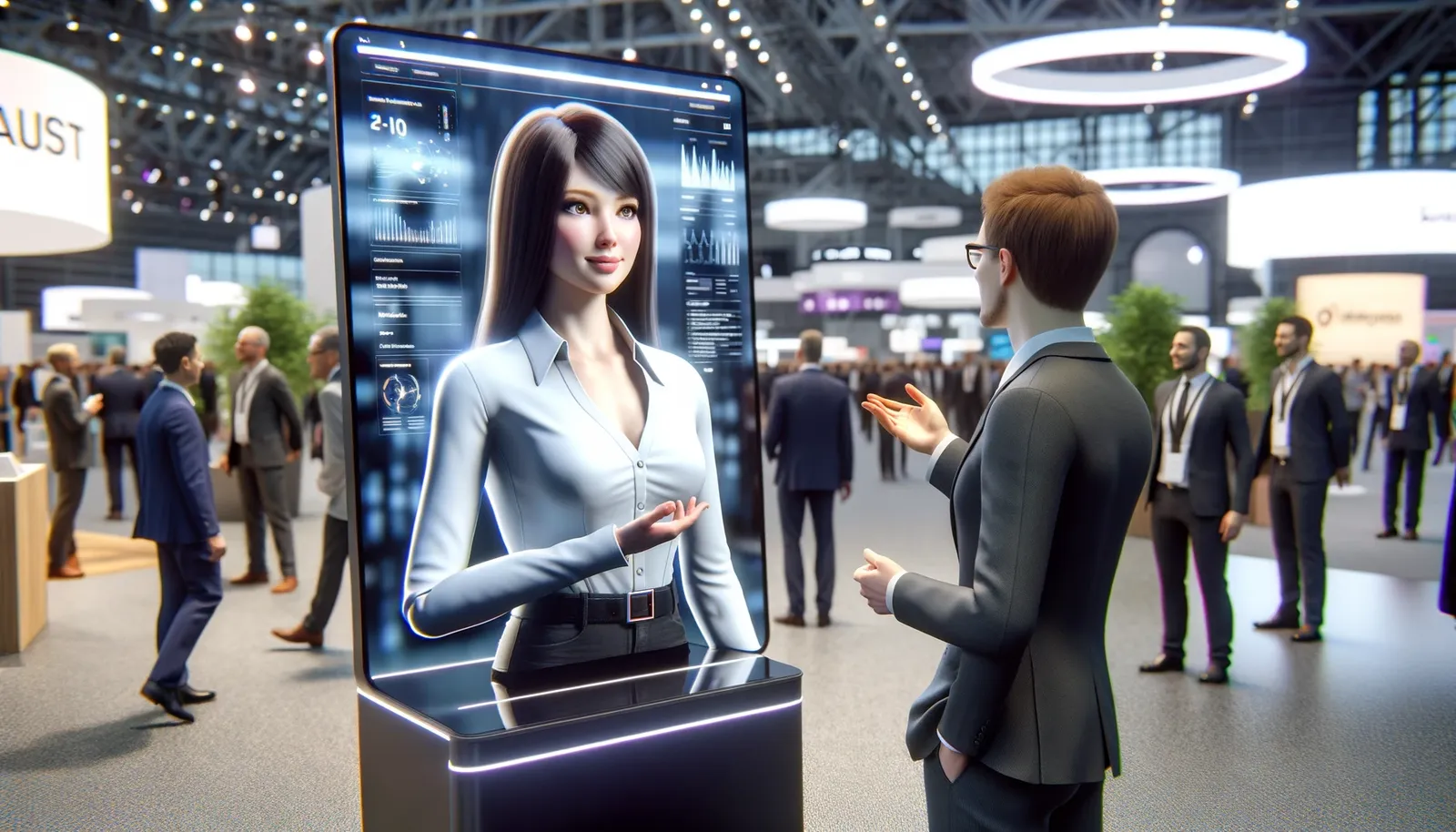
Imagine walking past a booth at a congress and being greeted by a friendly face on a large display. It belongs to an AI avatar that explains the product and answers your questions naturally and precisely.
AI avatars, also known as virtual avatars, are designed to reproduce human interaction authentically. They combine chatbot functions with artificial intelligence and are expressive and emotional. Their appearance and behaviour are modelled on real people so that the conversation feels familiar.
Traditional chatbots and virtual assistants are tools. An avatar adds a personality of its own and becomes a counterpart that holds real conversations. That personal, intuitive interaction is exactly what users look for today. The avatar is trained on the company’s own data so that every answer is accurate and relevant, and protecting sensitive information is a high priority.

How widespread AI avatars are
The technology is gaining ground in business because companies are looking for ways to engage customers and create new services. According to Emergen Research, the global digital human avatar market is expected to reach USD 561.16 billion by 2032, with a compound annual growth rate of 34.2%.
Source: Emergen Research, Digital Human Avatar Market, 2024 report
Avatars already work in many sectors. They make round-the-clock customer service possible, act as advisers in healthcare, teach in education and help shoppers in retail. In all of this they support employees, simplify processes and take over tasks. They are not meant to replace people.
Application examples for AI avatars
1.Banking and finance
In banks and financial services, avatars work as interactive customer service agents. They answer questions and explain financial topics at any time of day. They guide customers through simple transactions such as ordering a bank card, in a highly secure data environment. In financial apps and online banking, they improve the customer experience and strengthen trust in digital financial services.
2.Human resources and recruitment
In HR, avatars make onboarding new employees easier. They act as virtual trainers in training programmes or run pre-interviews with candidates, where the HR team would otherwise gather basic information. Because they appear human and deliver consistent quality, they give HR departments a scalable solution.
3.Sports
With advanced analysis tools, specialised avatars can evaluate athletes’ movements and suggest corrections in real time, for example in golf. Combined with 3D movement recognition, they give personal advice and expertise tailored to each athlete, which makes training more targeted. Our case study on 3D movement coaching in rehabilitation shows how 3D movement analysis works in practice.
4.Sales
In sales, avatars run product demonstrations and generate leads. They collect information and pass it straight to the sales team. In after-sales, they answer customer questions and help solve problems. Personal recommendations and responsiveness to customer wishes raise satisfaction and strengthen loyalty.
Our article AI Avatars: Bringing Digital Interactions to Life covers further scenarios, from reception to healthcare.
Integrating AI avatars takes specialist expertise
Connecting an avatar to a company’s internal systems is demanding. The technology comes from specialists who develop and implement digital avatars. Companies that want to bring avatars into their business processes should therefore work with experienced professionals.
At theBlue.ai we develop AI avatars and AI assistants as complete solutions. With each company we define where the avatar is used and how it fits its goals.
Conclusion: digital efficiency with a human face
AI avatars combine the efficiency of digital processes with the accessibility of a human conversation. That lifts customer experience and service quality to a new level. For customer engagement and corporate communication, they open up a new form of interaction between people and machines.

Planning an AI avatar?
In the process analysis we map your workflows, rank the possible use cases by return and propose an architecture. Fixed price from €3k.
Request a process analysisFrequently asked questions
AI avatars, also called virtual avatars, are digital figures with a human appearance. They combine chatbot functions with artificial intelligence, hold conversations and show facial expressions while doing so.
For example in customer service at banks and financial providers, for onboarding and pre-interviews in HR, for movement analysis in sports, and for product demonstrations and after-sales support in sales.
Emergen Research expects the global digital human avatar market to reach USD 561.16 billion by 2032, with a compound annual growth rate of 34.2%.
No. Avatars support teams, simplify processes and take over recurring tasks. Employees gain time for work that calls for experience and judgement.
Julia has been part of theBlue.ai since 2019 and has accompanied the development of AI applications in the enterprise environment since the company’s early days. In her role as Marketing Lead, she works closely with the engineering and consulting teams and makes complex technical topics understandable and accessible for decision-makers.
In her articles, she writes about practical experience from enterprise AI projects, as well as the challenges and opportunities of using AI in companies.